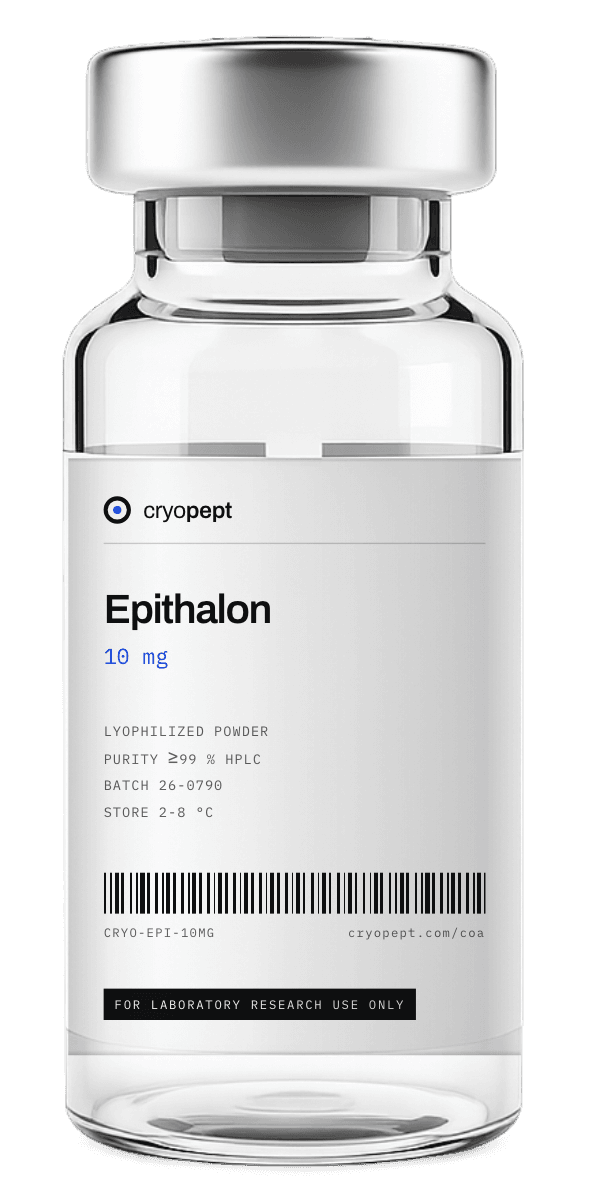
What is Epithalon?
Epithalon is one of the smallest bioactive peptides studied in ageing research: just four amino acids, alanine, glutamic acid, aspartic acid and glycine (C14H22N4O9, 390.4 g/mol). It was designed at the St. Petersburg Institute of Bioregulation and Gerontology by Professor Vladimir Khavinson's group, after decades of work with epithalamin, a polypeptide extract of bovine pineal glands that had shown anti-ageing effects in animals.
The idea behind Epithalon is simple: identify the shortest synthetic sequence that reproduces what the pineal extract does, then make it in pure, defined form. The pineal gland controls the body's melatonin rhythm, and its activity declines with age, so Epithalon became a research tool for asking whether supporting pineal function can slow biological ageing.
How such a small peptide works is still being mapped. The leading proposal is that Epithalon enters cells and interacts with specific regions of chromatin, switching on genes such as hTERT, the catalytic subunit of telomerase. Telomerase rebuilds telomeres, the protective caps at chromosome ends that shorten with every cell division and are one of the best-known biomarkers of ageing.
Benefits of Epithalon reported in research
Evidence level shown on each card.Activates telomerase and lengthens telomeres
In 2003, Khavinson and colleagues reported that Epithalon induced hTERT expression, telomerase activity and telomere elongation in telomerase-negative human fetal fibroblasts. An independent 2025 study from Brunel University London confirmed dose-dependent telomere lengthening in normal human fibroblasts and epithelial cells via hTERT upregulation.
Restores night-time melatonin in aged primates
In old rhesus monkeys (20 to 27 years), Epithalon increased the reduced night-time melatonin level, a hallmark of pineal ageing, while having no effect in young animals (Goncharova et al., 2005).
Normalises glucose and insulin regulation with age
The same primate study found that Epithalon lowered elevated basal glucose and insulin in old monkeys and normalised their insulin response to a glucose challenge, bringing it closer to that of young animals.
Extends maximum lifespan in mice
In a lifelong study of female SHR mice (Anisimov et al., 2003), Epithalon increased maximum lifespan by 12.3 % and the lifespan of the longest-lived 10 % of animals by 13.3 %, while mean lifespan was unchanged.
Protects chromosomes and reduces leukaemia in mice
The same mouse study reported 17.1 % fewer chromosome aberrations in bone marrow cells, a slower age-related decline of reproductive function and a 6-fold lower incidence of leukaemia compared with controls.
What the research shows
The pivotal cell study was published in 2003 in the Bulletin of Experimental Biology and Medicine. Khavinson, Bondarev and Butyugov added Epithalon to human fetal fibroblasts that normally have no telomerase activity. The cells began expressing the catalytic telomerase subunit, showed measurable enzyme activity and lengthened their telomeres, suggesting that the peptide can reactivate a silenced telomerase gene in ordinary body cells.
For two decades that finding came mainly from one research school, which made independent replication important. In 2025, Al-dulaimi and colleagues at Brunel University London published in Biogerontology a quantitative study in normal fibroblasts, normal epithelial cells and two breast cancer cell lines. In normal cells, Epithalon lengthened telomeres in a dose-dependent way by raising hTERT mRNA and telomerase activity. In the cancer lines, telomere lengthening ran instead through the ALT (alternative lengthening of telomeres) pathway, a distinction the authors highlight for future safety research.
Whole-organism data come from rodents and primates. Anisimov and colleagues (Biogerontology, 2003) followed 54 treated and 54 control female mice from 3 months of age until natural death. Epithalon did not change food intake, body weight or average lifespan, but it extended maximum lifespan by 12.3 %, reduced chromosome damage by 17.1 % and cut leukaemia incidence 6-fold. In rhesus monkeys, Goncharova et al. (Experimental Gerontology, 2005) showed that Epithalon raised night melatonin and improved glucose and insulin handling in old animals only, pointing to a restorative rather than stimulating effect.
Taken together, the evidence is strongest in cells and animals. Human data exist mainly as small studies from the originating Russian institute, so Epithalon is best viewed as a well-characterised research peptide for telomere, pineal and longevity biology.
Epithalon - frequently asked questions
What is Epithalon?
+
Epithalon (Epitalon) is a synthetic tetrapeptide, Ala-Glu-Asp-Gly, developed by Vladimir Khavinson's group in St. Petersburg. It is modelled on epithalamin, a pineal gland extract, and is studied for its effects on telomerase, melatonin rhythm and lifespan.
What are the benefits of Epithalon?
+
Research reports that Epithalon activates telomerase and lengthens telomeres in human cell cultures, restores night-time melatonin and glucose regulation in aged monkeys, and extends maximum lifespan by 12.3 % in mice. Most evidence comes from cell and animal studies.
Does Epithalon really lengthen telomeres?
+
Yes, in cell cultures. Telomere lengthening was first reported in human fibroblasts in 2003 and independently confirmed in normal human cells by a 2025 Brunel University London study, which linked it to higher hTERT expression and telomerase activity.
Epithalon vs epithalamin: what is the difference?
+
Epithalamin is a natural polypeptide extract from animal pineal glands, while Epithalon is a defined four-amino-acid synthetic peptide designed to reproduce its activity. The synthetic form can be made at high purity and verified batch by batch.
How should Epithalon be stored?
+
Keep lyophilized Epithalon sealed at -20 °C, dry and protected from light. Reconstituted solutions belong at 2-8 °C and should not be repeatedly frozen and thawed.
Is Epithalon legal in the EU?
+
Epithalon is not a controlled substance in the EU, but it is not authorised as a medicine by the EMA or any national agency. It is sold as a laboratory reagent, and this product is supplied for laboratory research use.