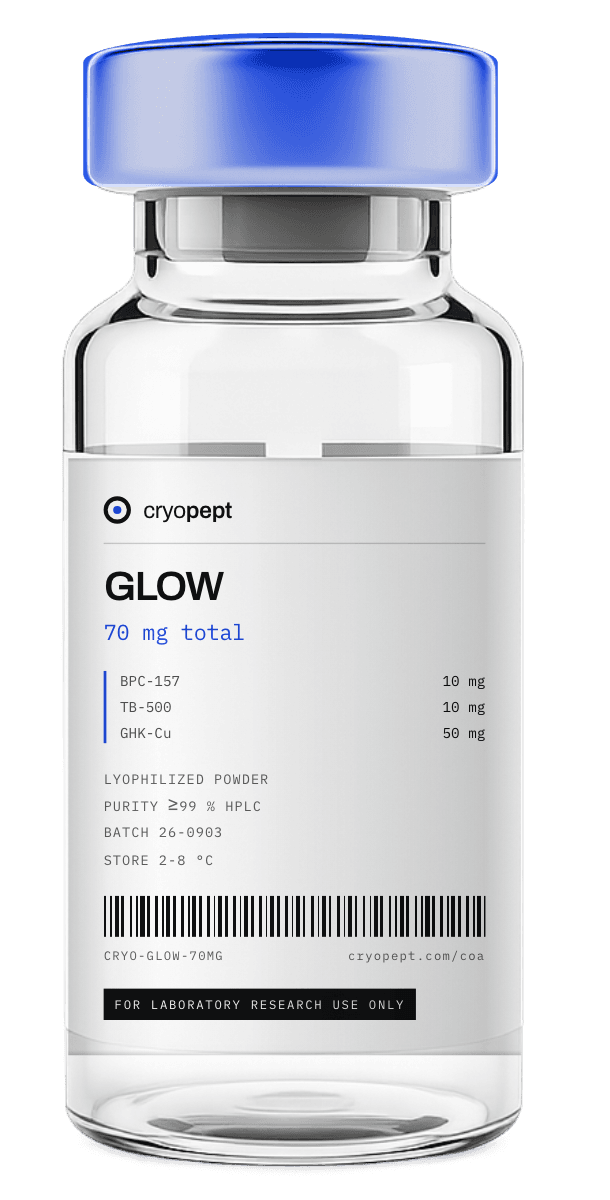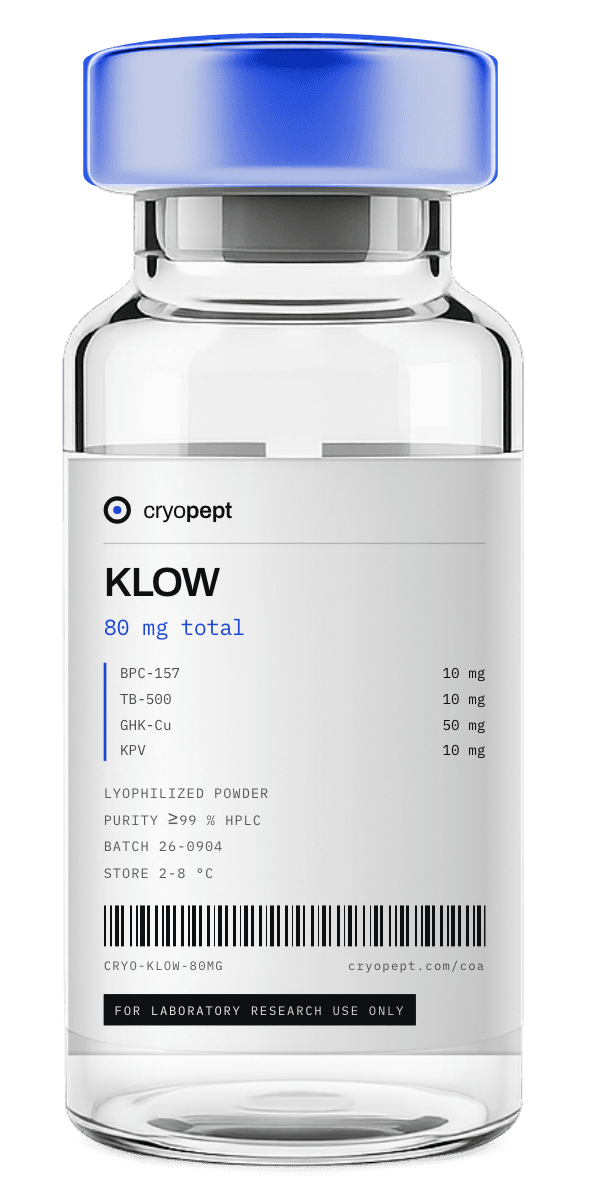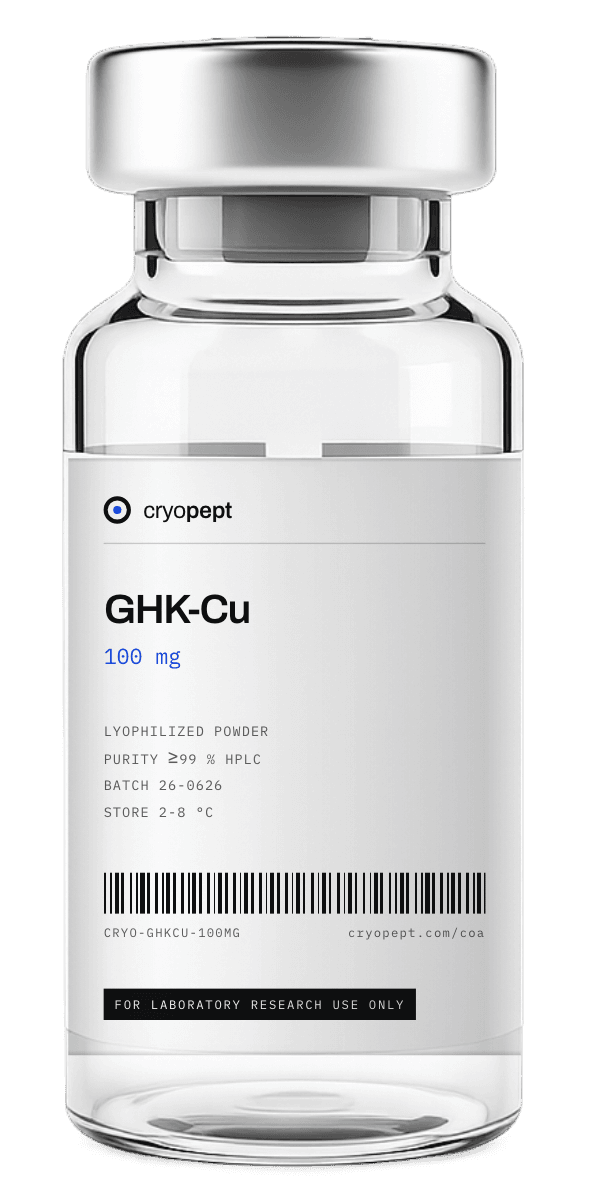
What is GHK-Cu?
GHK-Cu is a 1 : 1 complex of the tripeptide GHK (Gly-His-Lys, 340.4 g/mol) and a copper(II) ion. Biochemist Loren Pickart first isolated GHK from human plasma in 1973, when he noticed that plasma from young donors made liver tissue from older donors behave more like young tissue. The factor responsible turned out to be this small peptide, which binds copper with high affinity through its N-terminal glycine and the imidazole ring of histidine.
GHK is a natural part of human physiology, and its level declines with age: Pickart and Margolina (2018) cite roughly 200 ng/mL of plasma at age 20 falling to about 80 ng/mL by age 60. That decline, together with the peptide's repair-related activity, is why GHK-Cu has become one of the most studied peptides in skin biology, wound healing and ageing research.
In plain terms, GHK-Cu acts as a copper carrier and a signalling molecule. Copper is an essential cofactor for enzymes that build and cross-link the extracellular matrix, such as lysyl oxidase, and for antioxidant enzymes. GHK is thought to deliver copper to cells in a non-toxic form while also influencing gene activity directly, which helps explain the wide range of effects reported in the literature.
Benefits of GHK-Cu reported in research
Evidence level shown on each card.Stimulates collagen synthesis
In human fibroblast cultures, Maquart et al. (1988) found that GHK-Cu increased collagen production at concentrations as low as 1 nanomolar, independent of any change in cell number. Later studies extended this to elastin and glycosaminoglycans, the main building blocks of skin and connective tissue.
Accelerates wound healing
In rat, rabbit and other animal wound models, GHK-Cu improved wound contraction, granulation tissue formation and blood vessel growth. One rat study reviewed by Pickart and Margolina (2018) reported a 9-fold increase in collagen in wounds treated with a GHK-incorporated collagen dressing.
Improves the look of ageing skin
In a 12-week study of 71 women, a GHK-Cu facial cream increased skin density and thickness, reduced laxity and reduced the depth of fine lines and wrinkles. A separate 41-woman eye-cream study reported similar improvements versus placebo and a vitamin K cream.
Resets gene expression towards repair
Broad Institute Connectivity Map data show that GHK changes the expression of about 31 % of human genes by 50 % or more. In Campbell et al. (2012), GHK reversed an emphysema-linked gene signature and restored contractile function in lung fibroblasts taken from COPD patients.
Antioxidant and anti-inflammatory activity
Laboratory studies report that GHK can fully block copper-dependent oxidation of LDL and reduce iron release from ferritin by 87 %, limiting a key source of oxidative stress. Animal wound studies also recorded higher levels of antioxidant enzymes in GHK-treated tissue.
Supports nerve and hair follicle growth
Animal studies reviewed in 2018 report increased nerve growth factor and neurotrophins NT-3 and NT-4 with faster nerve fibre regeneration, and GHK-Cu analogues have been associated with larger hair follicles in skin models.
What the research shows
The foundation of GHK-Cu research is the 1988 FEBS Letters study by Maquart and colleagues. Working with fibroblast cultures, they showed that collagen synthesis began to rise at concentrations between 10^-12 and 10^-11 M and peaked at 10^-9 M. This established GHK-Cu as one of the most potent known signals for matrix production in cultured skin cells.
Animal wound research followed through the 1990s and 2000s. In healthy and diabetic rats, rabbits and other species, GHK-Cu consistently improved wound closure, angiogenesis and tissue antioxidant status. These models matter because impaired healing in diabetes and ageing is driven by exactly the processes GHK appears to support: matrix production, blood supply and control of oxidative damage.
The field was reshaped by gene-expression data. Using the Broad Institute Connectivity Map, researchers found that GHK shifts the activity of thousands of genes, with roughly 59 % of the affected genes upregulated and 41 % downregulated. In 2012, Campbell et al. (Genome Medicine) profiled 64 lung tissue samples from smokers with COPD, identified a gene signature of emphysematous destruction, and showed that GHK reversed it by activating TGF-beta repair pathways.
Human data come mainly from cosmetic trials of topical formulations. Controlled studies of 8 to 12 weeks, summarised by Pickart and Margolina (2018), report improved skin density, firmness and wrinkle depth, and one comparison found GHK-Cu raised collagen production in 70 % of participants versus 50 % for vitamin C and 40 % for retinoic acid. These are small studies, but they are consistent with the cell and animal findings.
GHK-Cu - frequently asked questions
What is GHK-Cu?
+
GHK-Cu is a copper complex of the tripeptide glycyl-L-histidyl-L-lysine, a molecule that occurs naturally in human plasma. It was discovered by Loren Pickart in 1973 and is widely studied for its effects on collagen production, wound repair and gene expression.
What are the benefits of GHK-Cu?
+
Research reports that GHK-Cu stimulates collagen, elastin and glycosaminoglycan synthesis in fibroblasts, speeds wound healing in animal models, and improves skin density and wrinkle depth in small cosmetic trials. Gene-expression studies show it shifts around 31 % of human genes towards a repair-oriented pattern.
Why does GHK-Cu decline with age?
+
Plasma GHK falls from about 200 ng/mL at age 20 to around 80 ng/mL by age 60, according to data cited by Pickart and Margolina (2018). The reason is not fully understood, but the drop coincides with the slower tissue repair seen in older organisms.
How should GHK-Cu be stored?
+
Lyophilized GHK-Cu is best kept sealed at -20 °C, protected from light and moisture. Reconstituted laboratory solutions should be refrigerated at 2-8 °C and not repeatedly frozen and thawed.
Is GHK-Cu legal in the EU?
+
Yes. GHK-Cu is not a controlled substance in the EU, and the same molecule is used in cosmetics under the INCI name Copper Tripeptide-1. This lyophilized product is supplied for laboratory research use.