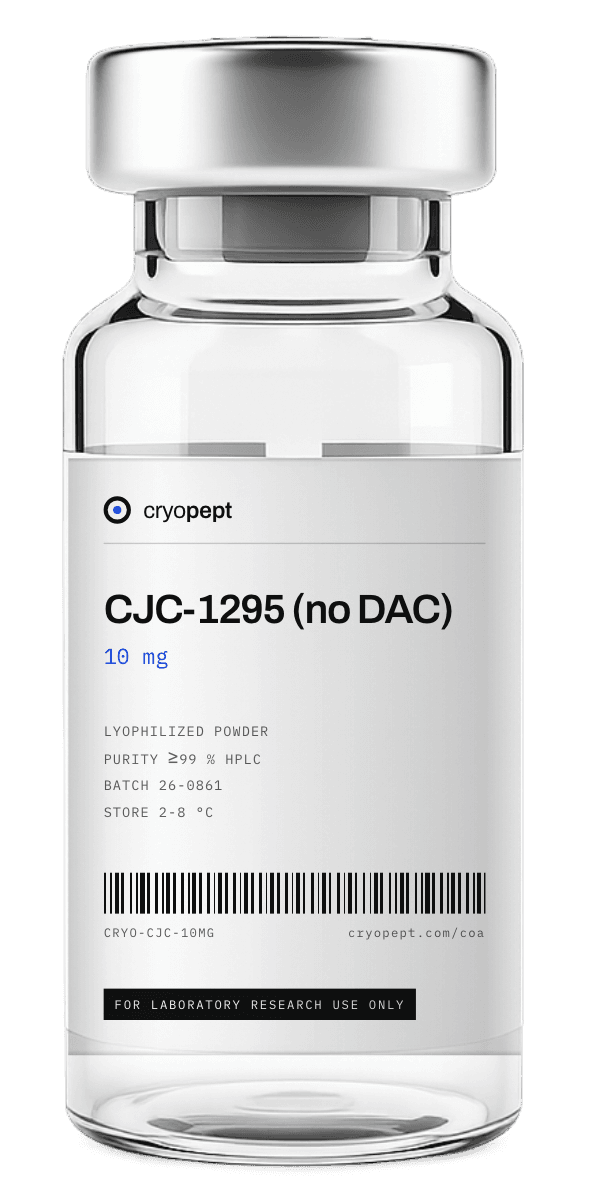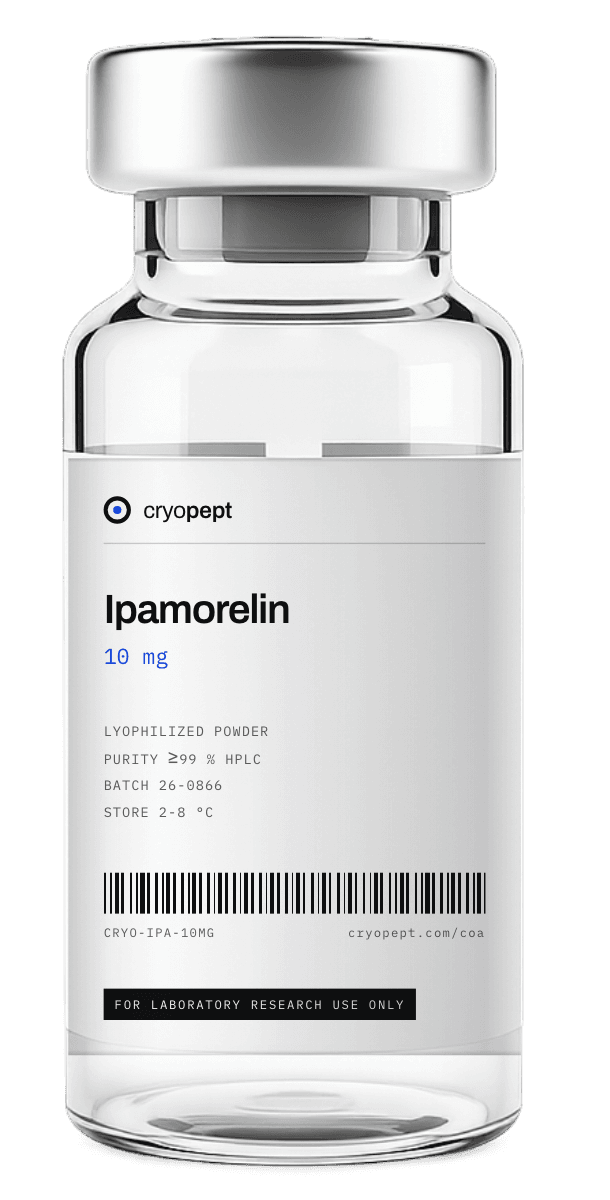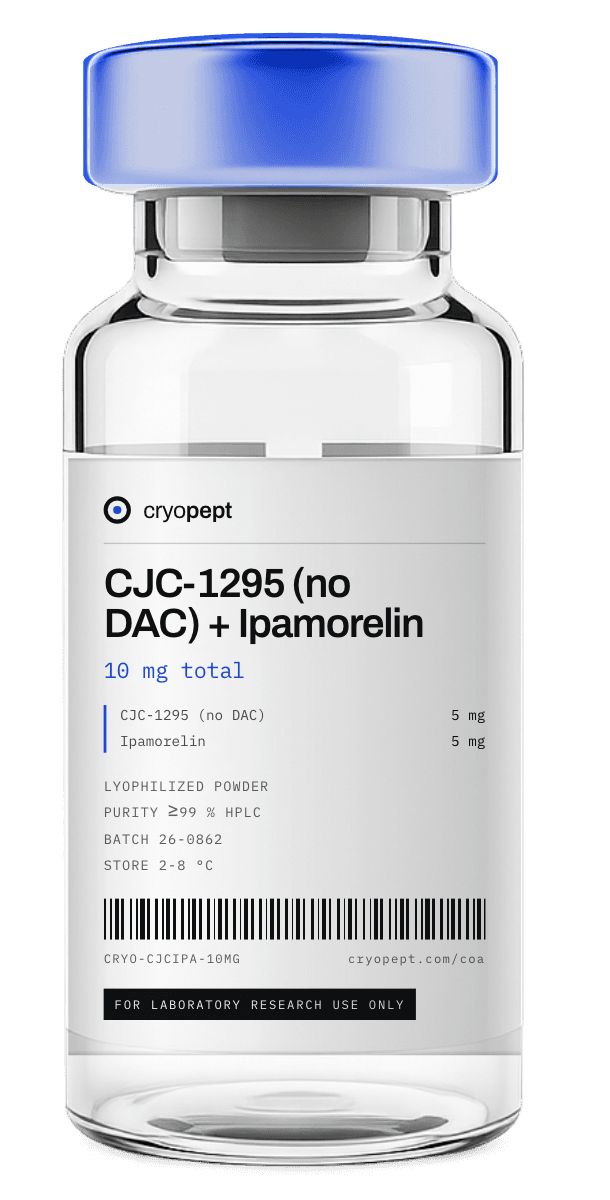
What is CJC-1295 (no DAC) + Ipamorelin?
This blend brings together the two main classes of growth hormone secretagogue. CJC-1295 no DAC (Modified GRF 1-29, 29 amino acids, 3367.9 g/mol) mimics the hypothalamic hormone GHRH. Ipamorelin (Aib-His-D-2-Nal-D-Phe-Lys-NH2, 5 amino acids, 711.9 g/mol) mimics ghrelin, the gut hormone that also acts on the pituitary. Each vial holds 5 mg of each peptide, 10 mg in total.
The pairing makes sense at the level of a single cell. CJC-1295 binds the GHRH receptor and signals through cAMP, which mainly increases how much growth hormone the somatotroph makes and releases per pulse. Ipamorelin binds GHS-R1a and signals through calcium, which triggers release and is thought to counter somatostatin, the hormone that normally puts the brakes on GH. Two routes, one target cell.
Both components are short-acting. CJC-1295 without DAC lacks the albumin-binding group of the long-acting version, and ipamorelin has a half-life of around 2 hours in humans. That makes the combination a research model of acute, pulse-shaped GH release rather than continuous stimulation.
Benefits of CJC-1295 (no DAC) + Ipamorelin reported in research
Evidence level shown on each card.Synergistic growth hormone release
In a 1990 study in 18 healthy men, submaximal doses of a growth hormone-releasing peptide given together with GHRH released GH synergistically, meaning more than the sum of each alone. The authors concluded the two act through independent systems, which is the core rationale for this blend.
Clean hormonal profile from ipamorelin
In swine, ipamorelin released GH without raising ACTH or cortisol, even at doses more than 200-fold above its effective dose, and did not change FSH, LH, prolactin or TSH. Older secretagogues such as GHRP-6 and GHRP-2 did raise ACTH and cortisol.
Stable GHRH signal from CJC-1295
The four substitutions in CJC-1295 no DAC protect the GRF(1-29) core from DPP-4 and oxidation. In the 2005 Endocrinology study that introduced CJC-1295, stabilised GRF(1-29) derivatives stayed bioactive and stimulated GH secretion in rat pituitary cells.
Supports bone growth and bone mass
In adult rats, ipamorelin dose-dependently increased the longitudinal growth rate of the tibia from 42 to up to 52 micrometres per day over 15 days, alongside greater body weight gain.
Protects muscle strength and bone formation
In a 3-month rat study, adding ipamorelin to glucocorticoid treatment increased calf muscle strength and raised periosteal bone formation four-fold compared with glucocorticoid alone, counteracting the catabolic effect of the steroid.
What the research shows
The scientific basis for combining a GHRH analogue with a ghrelin-receptor agonist goes back to Bowers et al. in the Journal of Clinical Endocrinology and Metabolism (1990). They gave healthy men the hexapeptide GHRP, GHRH(1-44), or both. Low doses of GHRP combined with GHRH produced a synergistic GH response, evidence that the two peptides use separate receptors and mechanisms.
Ipamorelin was designed at Novo Nordisk to keep this GH-releasing power while dropping the side-hormone effects of earlier GHRPs. Raun et al. (European Journal of Endocrinology, 1998) reported GH-releasing potency similar to GHRP-6 in rat pituitary cells and in swine, with a selectivity for GH comparable to GHRH itself. Follow-up rat studies from 1999 to 2001 linked it to faster bone growth, higher bone mineral content and protection against glucocorticoid-induced loss of bone formation and muscle strength.
CJC-1295 traces to Jetté et al. (Endocrinology, 2005), who stabilised hGRF(1-29) with four amino-acid substitutions. The no-DAC version in this blend uses that same backbone without the albumin anchor, so both components act briefly. No clinical trial has tested this exact two-peptide blend, so its research value rests on the separate literature for each component and on the well-documented GHRH plus GHRP synergy.
CJC-1295 (no DAC) + Ipamorelin - frequently asked questions
What is the CJC-1295 and Ipamorelin blend?
+
It is a single vial containing 5 mg of CJC-1295 without DAC and 5 mg of ipamorelin. CJC-1295 is a GHRH analogue and ipamorelin is a selective ghrelin-receptor agonist, so together they target both pituitary pathways that release growth hormone.
Why are CJC-1295 and ipamorelin combined?
+
They act on different receptors: CJC-1295 on the GHRH receptor through cAMP, ipamorelin on the ghrelin receptor GHS-R1a through calcium. Human research from 1990 showed that stimulating both pathways at once releases growth hormone synergistically, more than either pathway alone.
What are the benefits of CJC-1295 with ipamorelin?
+
Research reports synergistic GH release from combining GHRH and ghrelin-receptor signalling, and ipamorelin's selectivity means it did not raise cortisol or ACTH in animal studies. In rats, ipamorelin also increased bone growth and protected muscle strength and bone formation during glucocorticoid treatment.
Is the blend the same as buying CJC-1295 and ipamorelin separately?
+
The peptides are the same, but the blend supplies them pre-combined at a fixed 1:1 ratio by mass, 5 mg of each. Separate vials let researchers vary the ratio or study each peptide on its own, while the blend is convenient for work focused on the combination.
How should the CJC-1295 + Ipamorelin blend be stored?
+
Store the lyophilized blend sealed at -20 °C for long-term stability or 2-8 °C for short periods, away from light and moisture. Solutions are less stable than the powder and should be kept cold and not repeatedly frozen.
Is CJC-1295 with ipamorelin legal in the EU?
+
Neither peptide is an authorised medicine in the EU, and both fall under WADA's prohibited list for athletes. The blend is sold as a research material, and Cryopept supplies it for laboratory research use only.