What is Tesamorelin?
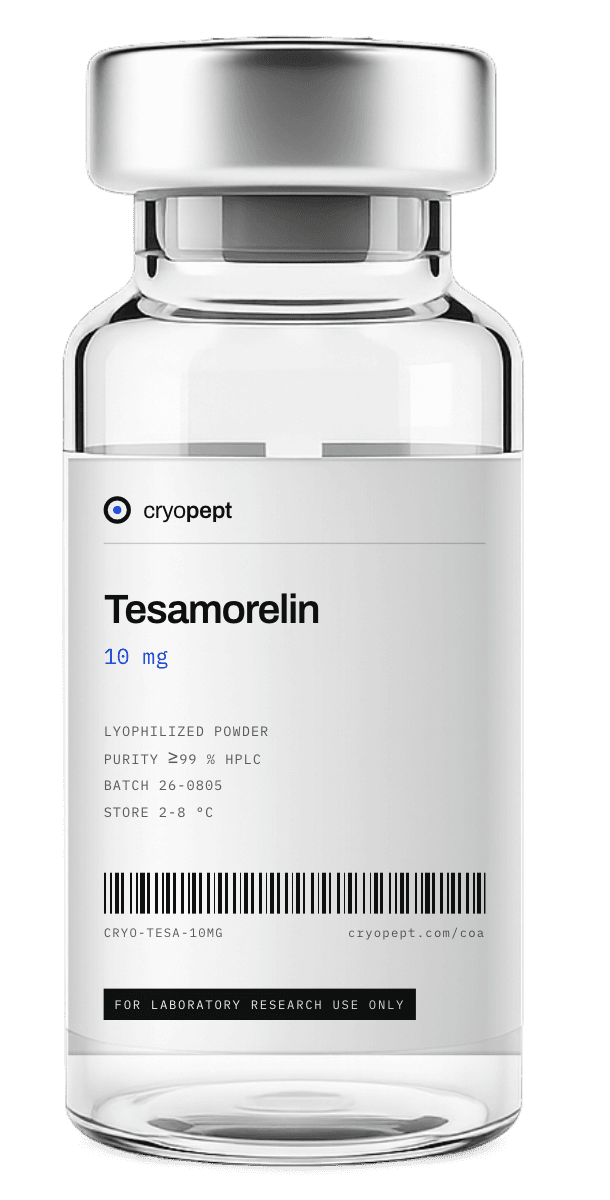
Tesamorelin (formula C221H366N72O67S, molar mass 5135.9 g/mol) contains all 44 amino acids of natural human GHRH. The only change is a trans-3-hexenoyl group attached to the first residue, tyrosine. That small cap protects the start of the chain from the DPP-4 enzyme, which otherwise inactivates native GHRH within minutes.
In plain language, tesamorelin tells the pituitary gland to make and release more of the body's own growth hormone (GH). It binds the GHRH receptor on somatotroph cells, which raises cAMP and triggers GH release in natural pulses. GH then prompts the liver to make IGF-1. Because the body's feedback loops stay in place, this is a different research model from giving GH itself.
Developed by the Canadian company Theratechnologies, tesamorelin was approved by the US FDA in November 2010 as Egrifta for reducing excess abdominal fat in adults with HIV-associated lipodystrophy. It remains the only GHRH analogue approved for that use.
Benefits of Tesamorelin reported in research
Evidence level shown on each card.Targets deep belly (visceral) fat
In the pivotal NEJM trial of 412 adults with HIV and abdominal fat accumulation, visceral fat measured by CT decreased by 15.2 % over 26 weeks with tesamorelin, compared with a 5.0 % increase on placebo.
Improves blood lipids
The same trial reported a 50 mg/dl fall in triglycerides versus a 9 mg/dl rise on placebo, and an improved total-to-HDL cholesterol ratio, with no significant change in glucose measures.
Raises IGF-1 through the body's own GH
Tesamorelin increased IGF-1 levels by 81.0 % in the 2007 trial, compared with a 5.0 % fall on placebo, confirming that it activates the natural GH / IGF-1 axis.
Reduces liver fat
In a 2019 Lancet HIV trial of 61 people with HIV and fatty liver disease, 12 months of tesamorelin cut liver fat by 37 % relative to baseline, and 35 % of participants reached a normal liver fat fraction below 5 %, versus 4 % on placebo.
Slowed fibrosis progression
In that same liver study, tesamorelin substantially slowed the high rate of liver fibrosis progression seen in the placebo group, and liver fat reductions were linked to fibrosis improvements.
Supported cognitive function in older adults
In a 20-week controlled trial of 152 adults aged 55 to 87 (Archives of Neurology, 2012), tesamorelin had a favourable effect on cognition, especially executive function, in both healthy older adults and people with mild cognitive impairment.
What the research shows
The landmark study is Falutz et al., New England Journal of Medicine, 2007. Researchers randomised 412 people with HIV and treatment-associated abdominal fat to tesamorelin or placebo for 26 weeks. Beyond the visceral fat result, total and HDL cholesterol also improved significantly, and patients reported better self-assessed body image. These results formed the core of the 2010 FDA approval.
Liver research followed at Massachusetts General Hospital. A 2014 JAMA trial in 50 HIV patients (Stanley et al.) found that six months of tesamorelin reduced both visceral fat and liver fat, with a net treatment effect of -2.9 % in lipid-to-water ratio. The larger 2019 Lancet HIV trial extended this to 12 months and liver biopsies, making tesamorelin one of the few agents studied specifically for fatty liver disease in HIV.
Brain research is a newer thread. Baker et al. (Archives of Neurology, 2012) gave tesamorelin or placebo to 152 older adults, 66 of them with mild cognitive impairment, and reported a positive effect on executive function and a trend toward better verbal memory, pointing to the GHRH / GH / IGF-1 axis as a target in brain ageing research.
In the EU, the Egrifta marketing application was withdrawn by the applicant in 2012 after the CHMP could not yet conclude on a positive benefit-risk balance, so tesamorelin is studied in Europe as a research compound rather than an authorised medicine.
Tesamorelin - frequently asked questions
What is tesamorelin?
+
Tesamorelin is a synthetic analogue of human growth hormone-releasing hormone (GHRH) made of all 44 natural amino acids plus a protective trans-3-hexenoyl group. It stimulates the pituitary to release the body's own growth hormone. In the US it is the approved medicine Egrifta.
What are the benefits of tesamorelin?
+
In clinical trials, tesamorelin reduced visceral abdominal fat by 15.2 % in 26 weeks, lowered triglycerides and raised IGF-1. Later studies reported reduced liver fat, slower liver fibrosis progression in people with HIV and fatty liver disease, and improved executive function in older adults.
Tesamorelin vs CJC-1295: what is the difference?
+
Both activate the GHRH receptor, but tesamorelin is the full 44-amino-acid GHRH sequence with an N-terminal cap, while CJC-1295 is a shorter 29-amino-acid fragment with four amino-acid substitutions. Tesamorelin is an FDA-approved medicine with large human trials; CJC-1295 is a research peptide with far less clinical data.
How should tesamorelin be stored?
+
Lyophilized tesamorelin keeps best sealed at -20 °C, with 2-8 °C acceptable for short periods, protected from light and moisture. Solutions are less stable than the powder and should be refrigerated and not refrozen repeatedly.
Is tesamorelin approved in the EU?
+
No. Tesamorelin is approved by the US FDA as Egrifta, but the European marketing application was withdrawn in 2012, so it is not an authorised medicine in the EU. Cryopept supplies tesamorelin for laboratory research use only.