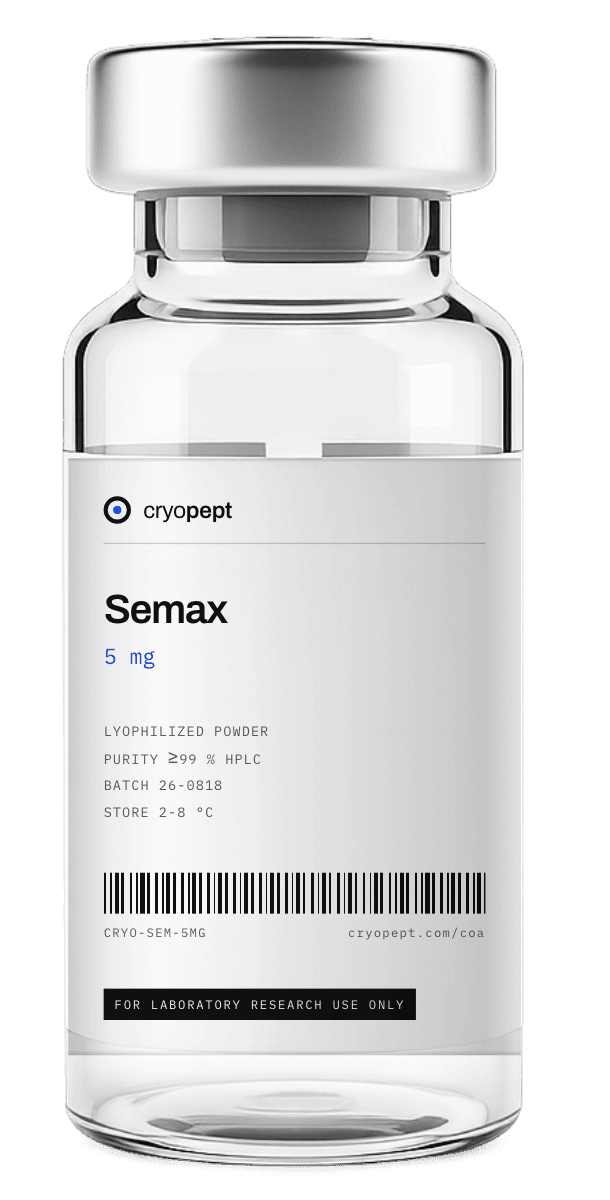
What is Semax?
Semax (C37H51N9O10S, 813.9 g/mol) was developed by researchers at the Institute of Molecular Genetics of the Russian Academy of Sciences and Moscow State University. Its first four residues, Met-Glu-His-Phe, are positions 4 to 7 of ACTH, a stretch known to influence attention and memory in animals. Because this short fragment is degraded quickly, a Pro-Gly-Pro tail was added, which slows enzymatic breakdown and prolongs activity. Semax is often described in the literature as an ACTH(4-10) analogue.
Crucially, the ACTH(4-7) core carries none of ACTH's hormonal activity: Semax does not stimulate the adrenal glands to release cortisol. Its effects are on the nervous system, which is why it has been developed as a nootropic and neuroprotective agent. Semax is registered as a medicine in Russia, where it is used in stroke and cognitive disorders, but it is not authorised anywhere in the EU.
The best-documented mechanism is neurotrophic. In rodent brain, Semax rapidly increases BDNF, the growth factor that supports neuron survival, synapse formation and memory consolidation, and activates its receptor TrkB. Research also points to effects on immune and vascular gene networks after brain ischaemia and to inhibition of the enzymes that degrade enkephalins.
Benefits of Semax reported in research
Evidence level shown on each card.Boosts BDNF and TrkB in the brain
In the rat hippocampus, a single Semax administration raised BDNF protein 1.4-fold, TrkB activation 1.6-fold, and BDNF and TrkB mRNA 3-fold and 2-fold respectively (Dolotov et al., 2006). BDNF is one of the most important growth factors for learning and neuronal resilience.
Enhances learning and memory
In the same 2006 study, Semax-treated rats showed a distinct increase in conditioned avoidance responses, a standard measure of learning. The authors linked this cognitive effect directly to activation of the hippocampal BDNF/TrkB system.
Neuroprotection after brain ischaemia
In a genome-wide study of rats after permanent middle cerebral artery occlusion, Semax shifted the expression of immune-response genes and of 24 vascular-system genes at 3 hours, including genes for endothelial migration and vessel formation (Medvedeva et al., 2014).
Supports recovery in stroke patients
In a 2018 Russian study of 110 patients after ischaemic stroke, those given Semax during rehabilitation had higher plasma BDNF levels, faster motor recovery and better Barthel index scores for daily-living independence. Semax is a registered medicine in Russia only.
Protects enkephalins from breakdown
In human serum, Semax inhibited enkephalin-degrading enzymes with an IC50 of about 10 µM, stronger than the peptidase inhibitors bacitracin and puromycin (Kost et al., 2001). This may contribute to its reported effects on stress resilience.
What the research shows
The key mechanistic study is Dolotov et al. (Brain Research, 2006). A single application of Semax in rats produced a maximal 1.4-fold rise in hippocampal BDNF protein, a 1.6-fold rise in TrkB tyrosine phosphorylation, and 3-fold and 2-fold rises in exon III BDNF and TrkB mRNA. Treated rats also performed better in conditioned avoidance learning. A companion paper the same year in the Journal of Neurochemistry showed that Semax binds specifically in the rat basal forebrain and increases BDNF protein there within hours, and a 2003 study had already found BDNF upregulation across several brain regions.
Stroke research forms the second pillar. Using permanent middle cerebral artery occlusion in rats, Medvedeva et al. (BMC Genomics, 2014) ran a genome-wide transcriptional analysis of ischaemic cortex. Semax predominantly enhanced immune-related genes, particularly immunoglobulins and chemokines, and altered 24 vascular-system genes at 3 hours and 12 at 24 hours after occlusion, pointing to effects on inflammation control and blood-vessel repair in damaged tissue. Later proteomic work in ischaemia-reperfusion models reported a consistent protective profile.
Human data come from Russia, where Semax is a registered medicine. Gusev et al. (2018) followed 110 patients in early and late rehabilitation after ischaemic stroke. Patients who received Semax had plasma BDNF levels that rose and stayed high throughout the study, and showed faster motor recovery and better final Barthel index scores than those who did not. These are open clinical studies rather than large blinded trials, so they rank below Western regulatory evidence, but they agree well with the animal BDNF data.
Semax - frequently asked questions
What is Semax?
+
Semax is a synthetic heptapeptide, Met-Glu-His-Phe-Pro-Gly-Pro, made from the ACTH(4-7) fragment plus a stabilising Pro-Gly-Pro tail. It was developed in Moscow and is registered as a nootropic and neuroprotective medicine in Russia.
What are the benefits of Semax?
+
Rat studies show that Semax raises BDNF and TrkB in the hippocampus, improves learning and protects brain tissue after ischaemia. A 2018 Russian study in 110 stroke patients linked Semax to higher plasma BDNF and better functional recovery.
Does Semax affect cortisol like ACTH?
+
No. Semax contains only the ACTH(4-7) fragment, which lacks the part of ACTH that stimulates the adrenal glands, so it does not act as a steroid-releasing hormone. Its research focus is on neurotrophic and neuroprotective effects.
Semax vs Selank: which is which?
+
Semax is built on an ACTH fragment and is studied mainly for cognition, BDNF and stroke recovery, while Selank is built on the immune peptide tuftsin and is studied mainly for anxiety and immune balance. Both carry a Pro-Gly-Pro tail and both come from the Institute of Molecular Genetics in Moscow.
How should Semax be stored?
+
Keep lyophilized Semax sealed at -20 °C, dry and protected from light, because its methionine residue can oxidise. Reconstituted solutions belong at 2-8 °C and should be used promptly.
Is Semax legal in the EU?
+
Semax is not a controlled substance in the EU, but it has no EU marketing authorisation; it is a registered medicine only in Russia. This product is supplied for laboratory research use.