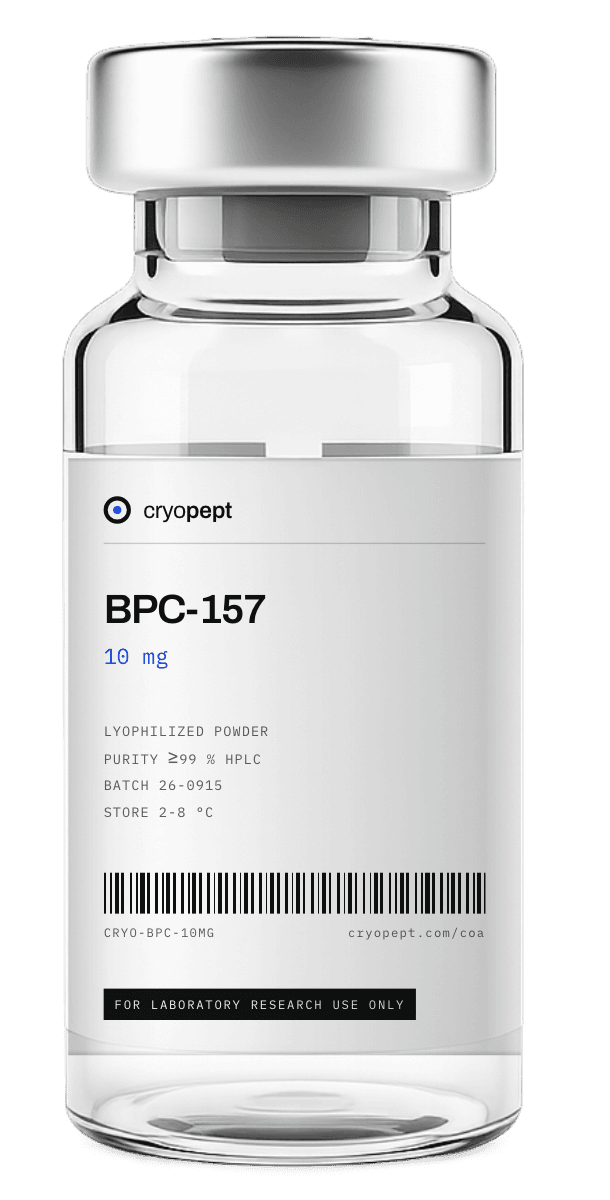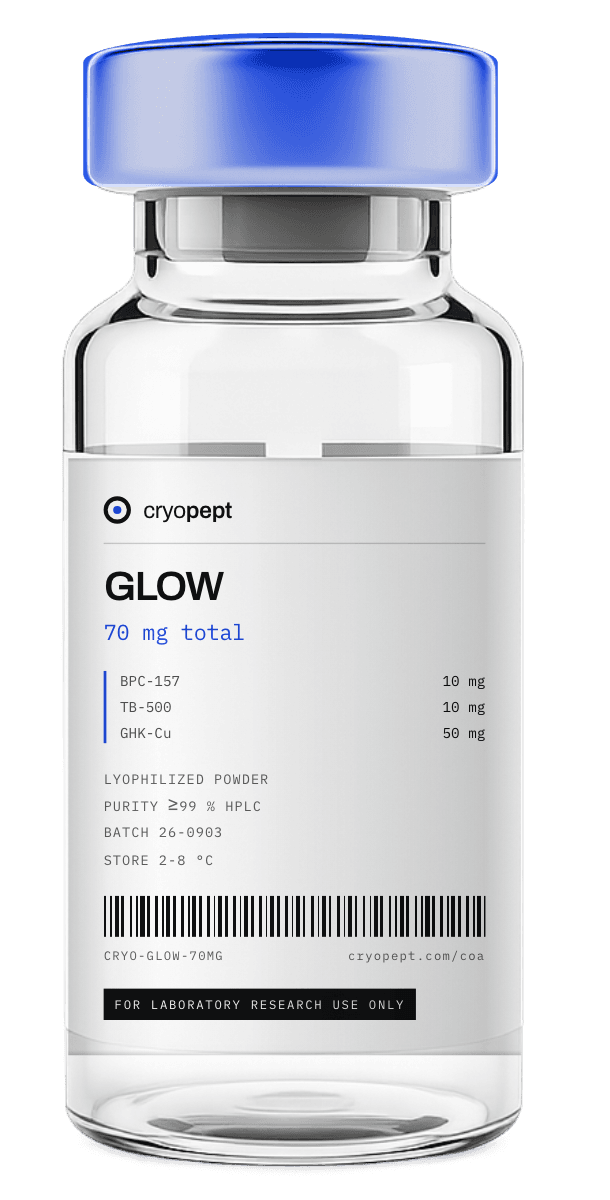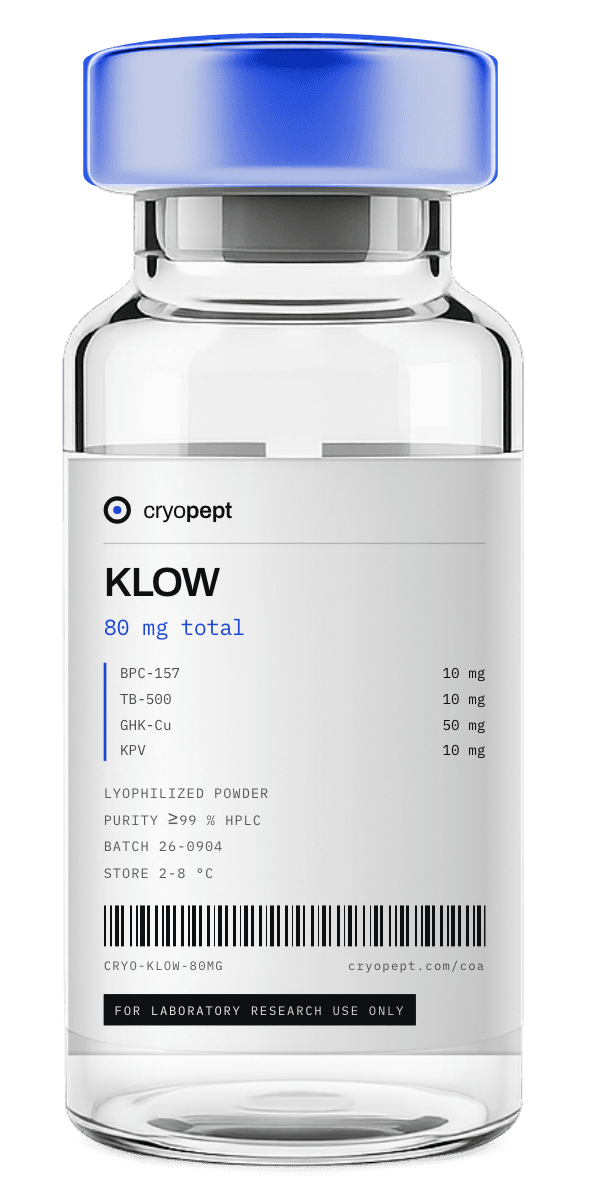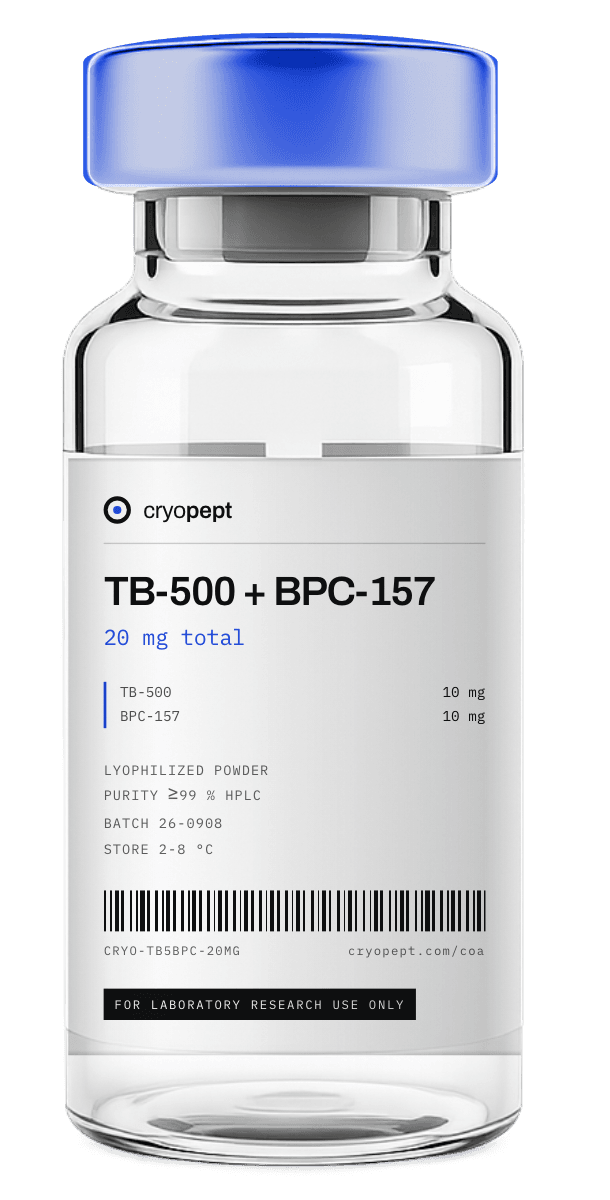
What is TB-500 + BPC-157?
This vial combines two peptides, co-lyophilized at 10 mg each for 20 mg in total. TB-500 is a synthetic peptide built around LKKTETQ, the actin-binding motif of thymosin beta-4, a 43-amino-acid protein present in almost every human cell and released in large amounts by platelets at injury sites. BPC-157 is a stable 15-amino-acid fragment (GEPPPGKPADDAGLV) of a protective protein from human gastric juice.
Why study them together? They cover different steps of repair. TB-500 binds G-actin, the building block of the cell skeleton, which is what cells use to crawl into a wound. BPC-157 is linked to VEGFR2 and nitric-oxide signalling that drive new blood vessel growth, plus FAK - paxillin signalling in tendon fibroblasts.
Put simply: one peptide helps cells move, the other helps bring blood supply and organise tendon cells. That complementary logic is why this pairing is one of the most researched combinations in regenerative peptide work, and it is also the core of the larger GLOW and KLOW blends.
Benefits of TB-500 + BPC-157 reported in research
Evidence level shown on each card.Faster wound closure (thymosin beta-4)
In a rat full-thickness wound model, thymosin beta-4 increased re-epithelialisation by 42 % at day 4 and up to 61 % at day 7 versus saline, with more collagen and new vessels (Malinda 1999).
Tendon and ligament repair (BPC-157)
BPC-157 restored full integrity of transected rat Achilles tendons within 14 days, with higher load-to-failure and better function than controls (Staresinic 2003).
Cell migration from two directions
Thymosin beta-4 stimulated keratinocyte migration 2-3-fold in vitro, while BPC-157 dose-dependently increased tendon fibroblast migration via FAK - paxillin, two separate routes to the same repair step.
Blood vessel growth
Both components are pro-angiogenic in research: thymosin beta-4 increased angiogenesis in healing rat wounds, and BPC-157 up-regulated VEGFR2 and restored blood flow in ischemic rat limbs (Hsieh 2017).
Heart tissue protection (thymosin beta-4)
In a 2004 Nature study, thymosin beta-4 promoted cardiac cell migration and survival and improved heart function after coronary ligation in mice.
What the research shows
Thymosin beta-4, the parent protein of TB-500, has a deep literature. Malinda et al. (J Invest Dermatol, 1999) reported 42 % more re-epithelialisation at day 4 and up to 61 % at day 7 in rat skin wounds, and Bock-Marquette et al. (Nature, 2004) showed it activates integrin-linked kinase and protects heart muscle after infarction in mice. Full-length thymosin beta-4 has also reached phase 2 human trials for venous ulcers and dry eye.
BPC-157's strongest data are musculoskeletal. Staresinic et al. (2003) and Cerovecki et al. (2010) reported faster, biomechanically stronger healing of rat Achilles tendon and knee ligament, and Hsieh et al. (2017) tied its pro-angiogenic effect to VEGFR2 - Akt - eNOS activation in human endothelial cells.
The combination itself has very little formal data. The only published human report is a 2021 retrospective chart review (Lee and Padgett) in which 4 patients received BPC-157 with thymosin beta-4 in the knee and 3 of the 4 reported relief. The rationale for pairing rests on the distinct, complementary mechanisms of each peptide rather than on combination trials.
TB-500 + BPC-157 - frequently asked questions
What is the TB-500 + BPC-157 blend?
+
It is a single vial containing 10 mg of TB-500 and 10 mg of BPC-157, two synthetic peptides studied for tissue repair. TB-500 is based on the actin-binding region of thymosin beta-4 and BPC-157 is a fragment of a gastric protective protein.
Why are TB-500 and BPC-157 researched together?
+
They act through different mechanisms. TB-500 binds actin and supports cell migration, while BPC-157 is linked to VEGFR2-driven blood vessel growth and tendon fibroblast signalling, so together they cover more steps of the repair process in animal models.
What are the benefits of TB-500 and BPC-157?
+
In rat studies, thymosin beta-4 accelerated skin wound closure by up to 61 % at day 7, and BPC-157 accelerated Achilles tendon and ligament healing. Both promoted new blood vessel growth. These findings come from animal and cell models, not controlled human trials.
Is TB-500 the same as thymosin beta-4?
+
Not exactly. Thymosin beta-4 is a natural 43-amino-acid protein, while TB-500 is a shorter synthetic peptide built around its actin-binding motif LKKTETQ. Much of the research cited for TB-500 was performed on full-length thymosin beta-4.
Is TB-500 + BPC-157 legal to buy in the EU?
+
Neither peptide is an authorised medicine in the EU, and both are prohibited in sport by WADA. Cryopept supplies this blend for laboratory research use.