- Four TRIUMPH phase 3 trials of retatrutide (Eli Lilly, GIP/GLP-1/glucagon triple agonist) have reported topline results between December 2025 and July 2026.
- Headline mean weight loss with the 12 mg dose: 28.3 % at 80 weeks in TRIUMPH-1 (no diabetes), 20.8 % in TRIUMPH-2 (type 2 diabetes), 22.6 % in TRIUMPH-3 (BMI 35+ with cardiovascular disease) and 28.7 % at 68 weeks in TRIUMPH-4 (knee osteoarthritis).
- 29 September 2026: TRIUMPH-2 became the first phase 3 retatrutide trial published in full in The Lancet, with 18.8 % mean weight loss at 12 mg on the stricter "treatment regimen" analysis and HbA1c down by up to 1.6 points.
- Safety is broadly GLP-1-like (mainly gastrointestinal), but dysesthesia - abnormal skin sensations - is a consistent, dose-related signal not seen in phase 2.
- Retatrutide is not approved anywhere. Lilly plans to file with the FDA in Q1 2027.
Retatrutide (LY3437943) is a single lipidated peptide that activates three hormone receptors: GIP, GLP-1 and glucagon. The first two are the targets of tirzepatide; adding glucagon receptor activity is intended to increase energy expenditure and liver fat oxidation. After a striking phase 2 result in 2023 (up to 24.2 % weight loss at 48 weeks, NEJM), Lilly launched the TRIUMPH phase 3 programme. In 2026 most of the key readouts arrived. This article collects them in one place, with the numbers that are confirmed by peer review separated from those that so far come only from company press releases.
The four TRIUMPH readouts at a glance
| Trial (reported) | Population | Length | Mean weight loss, 12 mg | Placebo |
|---|---|---|---|---|
| TRIUMPH-4 (Dec 2025) | Obesity + knee osteoarthritis | 68 weeks | 28.7 % | not stated in sources |
| TRIUMPH-1 (May 2026) | Obesity or overweight + comorbidity, no diabetes; n = 2,339 | 80 weeks | 28.3 % (9 mg 25.9 %, 4 mg 19.0 %) | 2.2 % |
| TRIUMPH-2 (Jul 2026; Lancet Sep 2026) | Obesity or overweight + type 2 diabetes; n = 1,152 | 80 weeks | 20.8 % (Lilly) / 18.8 % (Lancet, treatment regimen) | 4.0 % / 5.1 % |
| TRIUMPH-3 (Jul 2026) | BMI 35+ with established cardiovascular disease; n = 1,949 | 80 weeks | 22.6 % (9 mg 21.6 %) | 3.2 % |
TRIUMPH-1: the main obesity trial
TRIUMPH-1 randomised 2,339 adults with obesity, or overweight plus at least one weight-related condition, and without diabetes, to weekly retatrutide 4, 9 or 12 mg or placebo for 80 weeks. Lilly reported mean weight loss of 19.0 %, 25.9 % and 28.3 % respectively, versus 2.2 % on placebo. At 12 mg, 45.3 % of participants lost at least 30 % of their body weight. In a pre-specified group with a starting BMI of 35 or more who continued to 104 weeks, the 12 mg arm reached 30.3 %. The trial also contained two nested sub-studies, in knee osteoarthritis and obstructive sleep apnoea. Results were presented at the American Diabetes Association meeting in June 2026.
TRIUMPH-2: the first peer-reviewed phase 3 paper
TRIUMPH-2 enrolled 1,152 adults with a BMI of 27 or more and type 2 diabetes (mean HbA1c 7.7 %) at 92 centres in eight countries. It was published in The Lancet on 29 September 2026 (Bellido, le Roux et al.), at the same time as its presentation at EASD. People with type 2 diabetes typically lose less weight on incretin drugs than people without it, and that pattern holds here.
| Arm | Weight change, week 80 (Lancet) | Difference vs placebo | Diarrhoea | Nausea | Dysesthesia | Stopped due to adverse events |
|---|---|---|---|---|---|---|
| Placebo | -5.1 % | - | 13 % | 8 % | 1 % | 5 % |
| Retatrutide 4 mg | -11.9 % | -6.9 points | 27 % | 14 % | 4 % | 4 % |
| Retatrutide 9 mg | -16.8 % | -11.8 points | 34 % | 21 % | 6 % | 12 % |
| Retatrutide 12 mg | -18.8 % | -13.8 points | 34 % | 28 % | 7 % | 8 % |
Why does Lilly's press release say 20.8 % while the paper says 18.8 %? They use different estimands. The company headline uses the "efficacy" estimand, which estimates the effect if everyone had stayed on the drug. The Lancet primary analysis uses the "treatment regimen" estimand, which counts every randomised participant, including those who stopped. Both are legitimate; the second is closer to real-world use and is always the smaller number. Lilly also reported HbA1c reductions of up to 1.6 percentage points, versus 0.2 on placebo.
TRIUMPH-3 and TRIUMPH-4
- TRIUMPH-3 enrolled 1,949 adults with a BMI of 35 or more and established cardiovascular disease. Only the 9 mg and 12 mg doses were tested: 21.6 % and 22.6 % mean weight loss versus 3.2 % on placebo at 80 weeks, with improvements in lipids, blood pressure, hsCRP and waist circumference. It is not a cardiovascular outcomes trial; that question is being studied separately.
- TRIUMPH-4, the first phase 3 readout (December 2025), studied people with obesity and knee osteoarthritis. The 12 mg dose reached 28.7 % mean weight loss at 68 weeks, alongside improvements in knee pain and physical function scores.
The safety picture, including dysesthesia
Most adverse events were gastrointestinal - nausea, diarrhoea, constipation and vomiting - and were most common while the dose was being increased, as with other GLP-1-based drugs. In TRIUMPH-1, nausea was reported by 42.4 % on 12 mg versus 14.8 % on placebo, and discontinuation due to adverse events rose with dose from 4.1 % (4 mg) to 11.3 % (12 mg), versus 4.9 % on placebo.
The finding that drew most attention is dysesthesia: unusual skin sensations such as tingling, burning or sensitivity to touch. It was not reported in the phase 2 trial, but appeared in every phase 3 readout and rises with dose. TRIUMPH-4 reported it in 8.8 % (9 mg) and 20.9 % (12 mg) versus 0.7 % on placebo; in the TRIUMPH-2 paper the rates were 4-7 % versus 1 %. Lilly describes the cases as mostly mild to moderate and largely resolving during treatment. The mechanism is not established. TRIUMPH-2 also reported more hypotension (low blood pressure) at the higher doses: 5-6 % versus under 1 % on placebo.
What happens next
- Regulatory filing: Lilly says the data package is complete and plans to submit to the FDA in the first quarter of 2027, covering obesity and related conditions. An approval decision would normally follow about a year after filing.
- Head-to-head: TRIUMPH-5 compares retatrutide directly with tirzepatide and is due for primary completion around November 2026. Until then there is no randomised comparison between the two.
- Peer review: so far only TRIUMPH-2 is fully published. Full papers for the other trials, especially the TRIUMPH-1 detail on dysesthesia, will matter for the scientific assessment.
- EU status: retatrutide has no EU marketing authorisation and no EMA application has been announced.
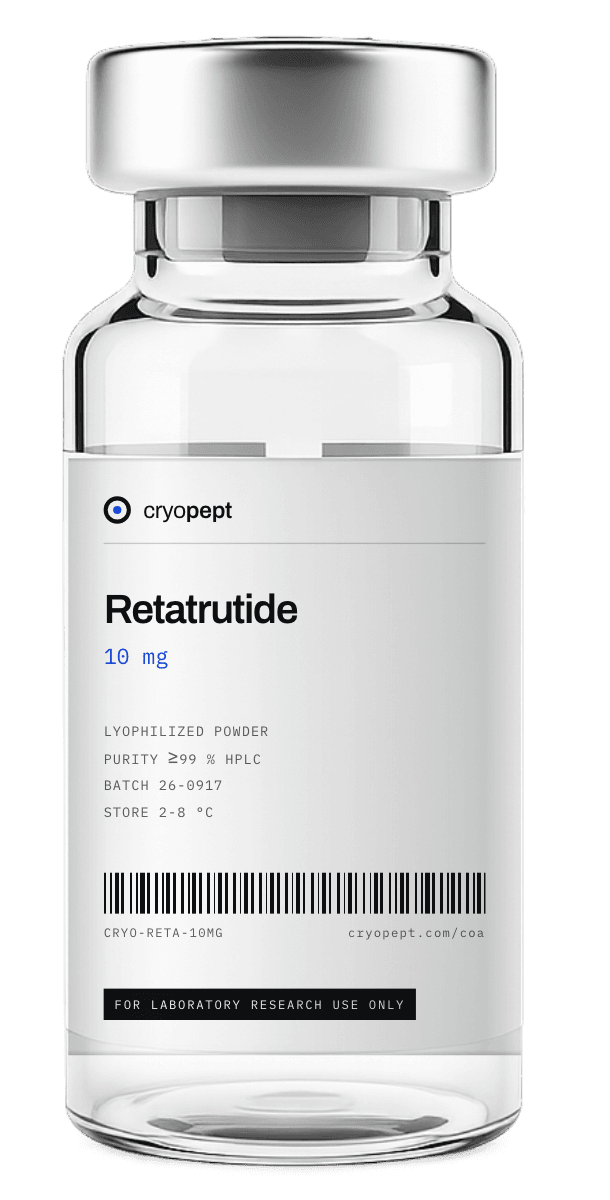
For researchers, TRIUMPH confirms that adding glucagon receptor agonism to the GIP/GLP-1 combination shifts the weight-loss range upward, at the cost of dose-related tolerability signals that the dual agonists do not show in the same way. This is why retatrutide is one of the most studied research peptides of 2026, and why its characterisation (identity by LC-MS, purity by HPLC) matters in any laboratory work with it.
Summary of published trial results for information only. Not medical advice. Retatrutide is an investigational compound; Cryopept Labs supplies it for laboratory research use only, not for human or veterinary use.