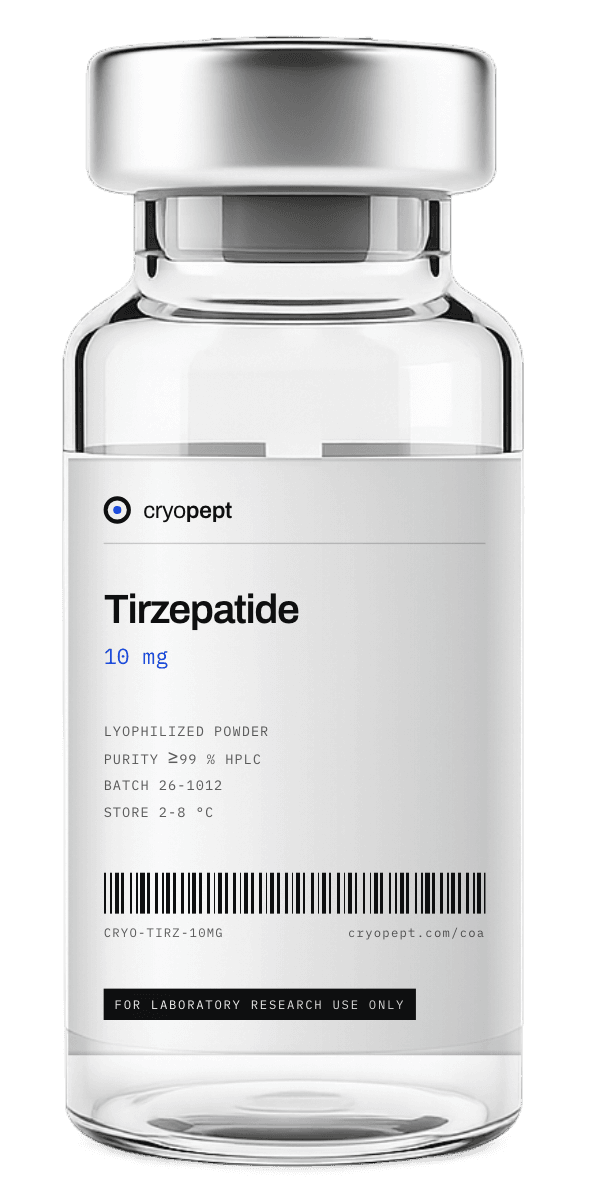
What is Tirzepatide?
Tirzepatide (formula C225H348N48O68, molar mass 4813.5 g/mol) was developed by Eli Lilly as the first dual GIP and GLP-1 receptor agonist. Its sequence is based on the natural hormone GIP, with two Aib residues that shield it from the DPP-4 enzyme and a C20 fatty diacid on lysine 20 that lets it ride on plasma albumin, so it stays active far longer than the native hormones.
In plain language, tirzepatide copies two gut hormones that the body releases after a meal. GLP-1 signalling is linked to fullness, slower stomach emptying and glucose-dependent insulin release, while GIP adds its own insulin and fat-tissue effects. Hitting both receptors at once is the idea that separated tirzepatide from single-receptor GLP-1 drugs.
The US FDA approved tirzepatide as Mounjaro for type 2 diabetes in 2022 and as Zepbound for chronic weight management in 2023, followed by an obstructive sleep apnea indication in 2024. In the EU it is authorised by the European Medicines Agency under the Mounjaro name.
Benefits of Tirzepatide reported in research
Evidence level shown on each card.Large, sustained weight reduction
In SURMOUNT-1, 2,539 adults with obesity or overweight lost 15.0 %, 19.5 % and 20.9 % of body weight across the three dose groups over 72 weeks, compared with 3.1 % on placebo. In the two higher dose groups, 50 % and 57 % of participants lost 20 % or more.
Stronger glucose control than semaglutide
In the 40-week SURPASS-2 trial in 1,879 people with type 2 diabetes, tirzepatide lowered HbA1c by 2.01 to 2.30 percentage points versus 1.86 with semaglutide, and every tirzepatide dose was superior on both HbA1c and body weight.
Outperformed semaglutide head to head in obesity
The SURMOUNT-5 trial (NEJM, 2025) compared the two drugs directly in 751 adults with obesity. After 72 weeks, weight fell by 20.2 % with tirzepatide versus 13.7 % with semaglutide, and waist circumference by 18.4 cm versus 13.0 cm.
Fewer breathing interruptions in sleep apnea
In the SURMOUNT-OSA trial without airway-pressure therapy, adults with moderate-to-severe obstructive sleep apnea and obesity saw the apnea-hypopnea index fall by 25.3 events per hour on tirzepatide versus 5.3 on placebo after 52 weeks, which led to the 2024 FDA approval for this use.
Broad cardiometabolic improvements
Across the SURMOUNT-1 population, improvements were reported in every prespecified cardiometabolic measure, including waist circumference, blood pressure, lipids and fasting insulin, alongside the weight loss itself.
What the research shows
The pivotal obesity study is SURMOUNT-1 (Jastreboff et al., New England Journal of Medicine, 2022). It randomised 2,539 adults with a mean starting weight of 104.8 kg to tirzepatide or placebo for 72 weeks. At least 5 % weight loss was reached by 85 % to 91 % of participants on tirzepatide versus 35 % on placebo, a result that set a new benchmark for an anti-obesity medicine at the time.
The diabetes programme, SURPASS, established the glucose-lowering case. In SURPASS-2 (Frías et al., NEJM, 2021), tirzepatide was both non-inferior and superior to semaglutide on HbA1c at 40 weeks and produced an extra 1.9 to 5.5 kg of weight loss depending on dose. The mean starting HbA1c in that trial was 8.28 %.
Direct comparisons and new indications followed. SURMOUNT-5 (Aronne et al., NEJM, 2025) confirmed a 6.5-point advantage in percent weight loss over semaglutide in adults without diabetes. SURMOUNT-OSA (Malhotra et al., NEJM, 2024) ran two parallel 52-week trials in sleep apnea, with and without positive airway pressure therapy, and showed large reductions in breathing events per hour in both.
For laboratory work, tirzepatide is used as a reference dual incretin agonist: to compare GIP and GLP-1 receptor signalling, to benchmark newer multi-receptor peptides such as retatrutide, and to study cAMP signalling in beta-cell and adipocyte models.
Tirzepatide - frequently asked questions
What is tirzepatide?
+
Tirzepatide is a synthetic 39-amino-acid peptide that activates both the GIP and GLP-1 receptors. It was developed by Eli Lilly and is the active ingredient of the approved medicines Mounjaro and Zepbound. A fatty-acid side chain binds albumin, which keeps it active for days rather than minutes.
What are the benefits of tirzepatide?
+
In clinical trials, tirzepatide produced average weight loss of up to 20.9 % over 72 weeks (SURMOUNT-1), lowered HbA1c by up to 2.30 percentage points in type 2 diabetes (SURPASS-2) and reduced sleep apnea events in people with obesity (SURMOUNT-OSA). It also improved waist size, blood pressure and lipid markers.
Tirzepatide vs semaglutide: which works better?
+
Two head-to-head trials favour tirzepatide. In SURPASS-2 it lowered HbA1c more than semaglutide in type 2 diabetes, and in SURMOUNT-5 it produced 20.2 % weight loss versus 13.7 % for semaglutide over 72 weeks. The key difference is that tirzepatide adds GIP receptor activity to GLP-1.
Tirzepatide vs retatrutide: what is the difference?
+
Tirzepatide is an approved dual agonist of the GIP and GLP-1 receptors. Retatrutide is an investigational triple agonist that also activates the glucagon receptor and is still in phase 3 trials. Both are 39-amino-acid lipidated peptides, but only tirzepatide is an authorised medicine.
How should tirzepatide powder be stored?
+
Lyophilized tirzepatide is best kept sealed at -20 °C for long-term storage and at 2-8 °C for short periods, away from light and moisture. Allowing the vial to warm to room temperature before opening helps prevent condensation.
Is tirzepatide legal in the EU?
+
Yes, tirzepatide is authorised in the EU as the prescription medicine Mounjaro. The research-grade tirzepatide sold by Cryopept is a separate product supplied for laboratory research use only.