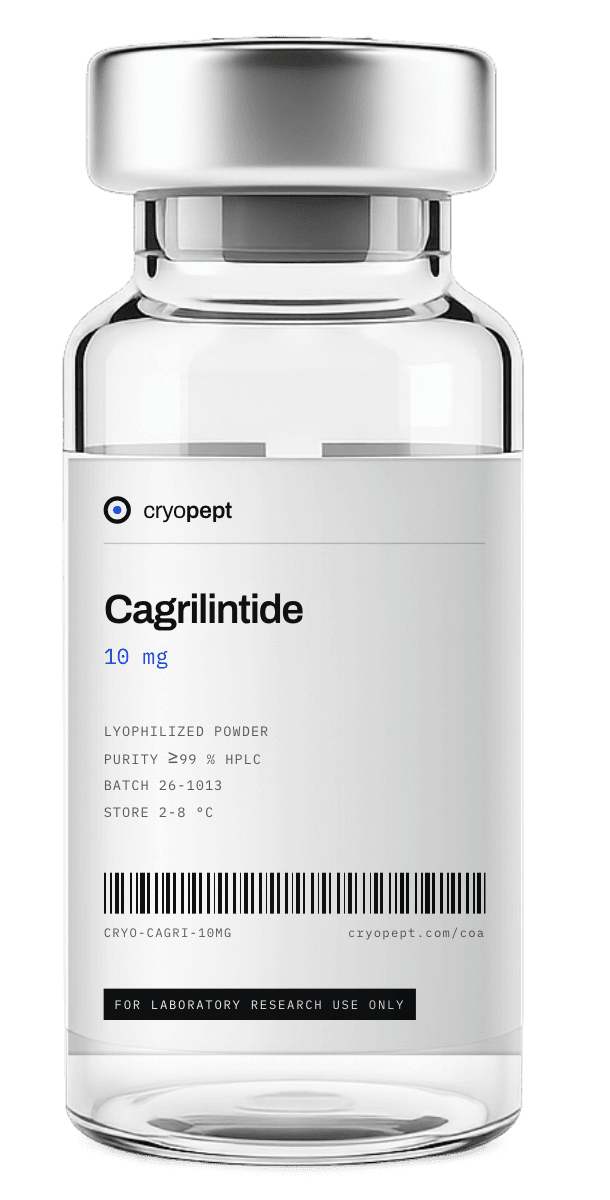
What is Cagrilintide?
Amylin is a 37-amino-acid hormone released together with insulin by pancreatic β-cells after a meal. It signals fullness to the brain, slows gastric emptying and suppresses glucagon after eating. Native amylin is hard to use as a drug: it has a strong tendency to clump into amyloid fibrils and is cleared within minutes. The first analogue, pramlintide, fixed the clumping but still needs injections before every meal.
Cagrilintide was designed by Novo Nordisk scientists (Kruse et al., Journal of Medicinal Chemistry, 2021) to solve both problems. It keeps the 37-residue amylin backbone with the disulfide ring between cysteines 2 and 7, carries substitutions that stabilise it against fibril formation, and has a C20 fatty diacid attached at the N-terminus through a γ-glutamate linker. The fatty acid binds albumin in plasma, giving a half-life of about one week. Its molar mass is about 4409 g/mol (C194H312N54O59S2).
Pharmacologically, cagrilintide is a non-selective agonist of the amylin receptors (AMY1-3, formed by the calcitonin receptor paired with RAMP1, 2 or 3) and of the calcitonin receptor itself. These are class B G-protein-coupled receptors that signal through Gαs and cAMP, and they are dense in the area postrema and hypothalamus, the brain regions that regulate satiety.
Benefits of Cagrilintide reported in research
Evidence level shown on each card.Weight reduction as a single agent
In a phase 2 trial in 706 adults with overweight or obesity, 26 weeks of once-weekly cagrilintide reduced body weight by 6.0 % to 10.8 % across doses versus 3.0 % with placebo. The highest dose also outperformed liraglutide 3.0 mg (10.8 % vs 9.0 %).
Additive effect with semaglutide
In the 68-week phase 3 REDEFINE 1 trial in 3417 adults, cagrilintide plus semaglutide (CagriSema) reduced body weight by 20.4 % versus 3.0 % with placebo, more than either component alone.
Studied in type 2 diabetes
In a 32-week phase 2 trial in type 2 diabetes, CagriSema improved HbA1c and continuous glucose monitoring time in range and produced significantly greater weight loss than semaglutide or cagrilintide alone. The phase 3 REDEFINE 2 trial extended this to adults with obesity and type 2 diabetes.
Targets satiety through a non-GLP-1 pathway
Amylin receptors in the area postrema and hypothalamus act on fullness signalling independently of GLP-1. This is why amylin analogues are researched as a complement to incretin drugs rather than a replacement.
Once-weekly pharmacokinetics
Lipidation and albumin binding extend the half-life of cagrilintide to roughly one week, compared with the short action of native amylin and pramlintide, which allowed weekly dosing in all clinical trials.
What the research shows
The medicinal chemistry was published by Kruse et al. in the Journal of Medicinal Chemistry in 2021. The team screened amylin analogues for chemical and physical stability, receptor potency and duration of action, and selected cagrilintide (compound 23) because it combined resistance to fibril formation with a long half-life suitable for weekly use.
The first clinical data came from a phase 1b study combining cagrilintide with semaglutide (Enebo et al., Lancet, 2021), followed by a dose-finding phase 2 trial of cagrilintide alone (Lau et al., Lancet, 2021). In that trial all five doses produced greater weight loss than placebo after 26 weeks, and the most common adverse events were gastrointestinal, such as nausea, constipation and diarrhoea.
Phase 3 work focuses on the combination CagriSema. REDEFINE 1 (Garvey et al., New England Journal of Medicine, 2025) reported a 20.4 % mean weight reduction at 68 weeks versus 3.0 % on placebo, with mostly transient, mild to moderate gastrointestinal events. REDEFINE 2 (Davies et al., NEJM, 2025) studied adults with type 2 diabetes. A head-to-head trial against tirzepatide (REDEFINE 4) did not meet its primary endpoint in early 2026.
Regulatory status at the time of this review: Novo Nordisk submitted CagriSema to the US FDA in December 2025, with a decision guided for the fourth quarter of 2026. Neither cagrilintide alone nor CagriSema is an approved medicine in the EU or US yet.
Cagrilintide - frequently asked questions
What is cagrilintide?
+
Cagrilintide is a long-acting synthetic analogue of amylin, a pancreatic hormone involved in satiety. It was developed by Novo Nordisk and acts on amylin and calcitonin receptors with a half-life of about one week.
What is the difference between cagrilintide and CagriSema?
+
Cagrilintide is the single amylin analogue. CagriSema is Novo Nordisk's investigational combination of cagrilintide with the GLP-1 receptor agonist semaglutide, given together once a week.
How does cagrilintide differ from semaglutide or tirzepatide?
+
Semaglutide and tirzepatide act on incretin receptors (GLP-1, and GLP-1 plus GIP). Cagrilintide acts on amylin and calcitonin receptors, a separate satiety pathway, which is why it is studied in combination with incretin drugs.
Is cagrilintide FDA approved?
+
Not yet. Novo Nordisk filed CagriSema with the FDA in December 2025 and guided to a US decision in the fourth quarter of 2026. Cagrilintide is not an approved medicine in the EU.
What were the cagrilintide phase 2 results?
+
In the 26-week phase 2 trial (Lau et al., Lancet, 2021), weight reductions ranged from 6.0 % to 10.8 % across cagrilintide doses versus 3.0 % with placebo, and the top dose exceeded liraglutide 3.0 mg.