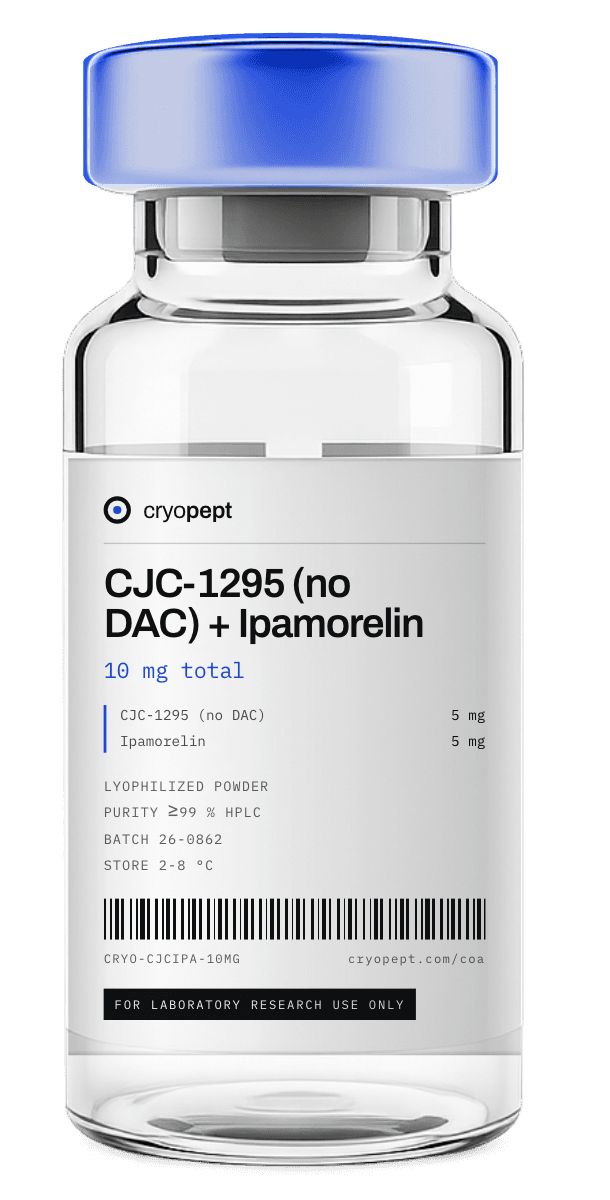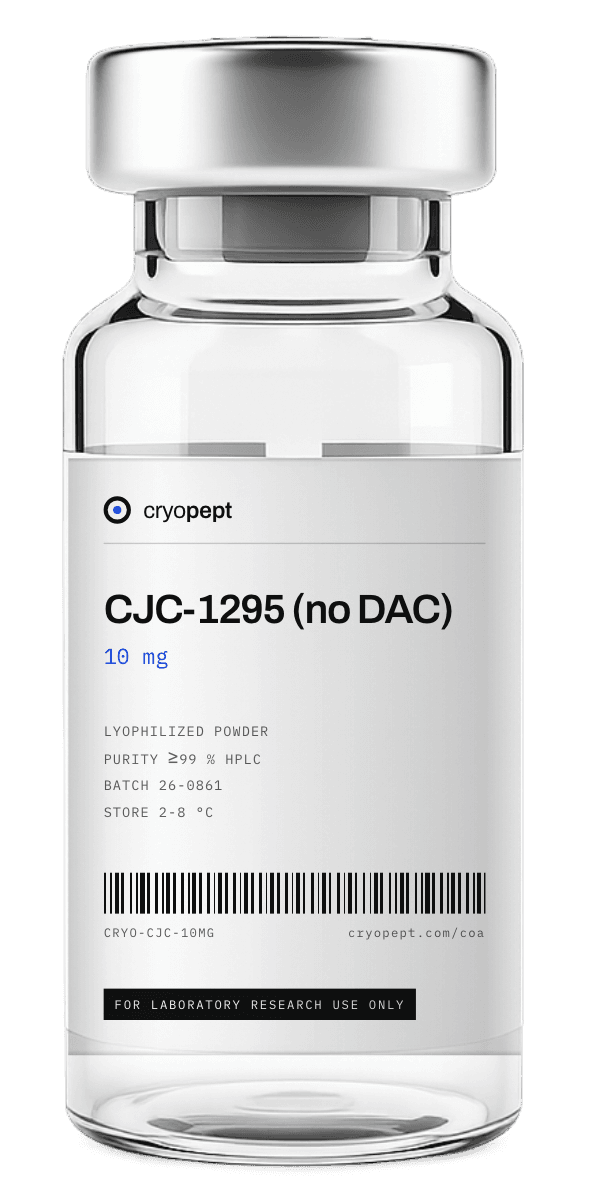
What is CJC-1295 (no DAC)?
CJC-1295 no DAC (formula C152H252N44O42, molar mass 3367.9 g/mol) copies the first 29 amino acids of human GHRH, the shortest part of the hormone that keeps its full biological activity. Four residues are swapped: D-alanine at position 2, glutamine at 8, alanine at 15 and leucine at 27. These changes shield the peptide from the DPP-4 enzyme and from oxidation, so it survives far longer than native GRF(1-29), which is known as sermorelin.
The name comes from the Canadian company ConjuChem. Its CJC-1295 program added a Drug Affinity Complex (DAC), a lysine-linked maleimide that binds blood albumin and stretches the half-life to about a week. The version without DAC keeps the same tetrasubstituted backbone but leaves out that anchor, so it acts briefly, closer to the body's own GHRH bursts.
In plain terms, CJC-1295 no DAC binds the GHRH receptor on pituitary somatotroph cells. This raises cAMP, activates the PKA and CREB pathway, and switches on growth hormone production and release. The liver then responds to GH by making IGF-1.
Benefits of CJC-1295 (no DAC) reported in research
Evidence level shown on each card.Built on the fully active GHRH fragment
GRF(1-29) is the shortest synthetic GHRH sequence with full biological activity, and in human studies it specifically stimulated growth hormone release from the anterior pituitary. CJC-1295 no DAC keeps this active core.
Greater enzymatic stability
Each of the four swaps has a job: D-Ala2 protects the N-terminus from DPP-4, the enzyme that rapidly inactivates native GHRH; Gln8 replaces an asparagine prone to deamidation; Ala15 strengthens receptor binding; and Leu27 replaces an oxidation-prone methionine. Together they keep the GRF(1-29) chain intact far longer in laboratory conditions.
Pulse-like growth hormone release
Without the albumin-binding DAC, the peptide acts for a short time, which lets researchers study short bursts of GHRH-receptor signalling that resemble natural GH pulses rather than continuous stimulation.
Strong link to the GH / IGF-1 axis
In healthy adults, the long-acting DAC form of CJC-1295 raised growth hormone 2- to 10-fold and IGF-1 1.5- to 3-fold, showing that this stabilised GRF(1-29) backbone drives the full GH / IGF-1 cascade in humans.
Synergy with ghrelin-receptor peptides
A classic 1990 study in healthy men showed that GHRH combined with a growth hormone-releasing peptide released GH synergistically, because the two act on different receptors. This is why GHRH analogues like CJC-1295 are often researched alongside ipamorelin.
What the research shows
The CJC-1295 name was introduced by Jetté et al. in Endocrinology (2005). The team built three maleimide derivatives of hGRF(1-29) designed to bind albumin; all showed improved stability against DPP-4 and activated GH secretion in cultured rat pituitary cells. The lead compound, CJC-1295 with DAC, gave a 4-fold larger GH response in rats than native hGRF(1-29) over two hours and remained in plasma beyond 72 hours.
Human data come mainly from the DAC form. Teichman et al. (Journal of Clinical Endocrinology and Metabolism, 2006) reported dose-dependent GH increases for 6 days or more after a single injection, and IGF-1 above baseline for up to 28 days after repeated doses. Ionescu and Frohman (2006) showed that GH secretion stayed pulsatile under that continuous stimulation, with trough GH 7.5-fold higher and IGF-1 up 45 %. These findings are for CJC-1295 with DAC; dedicated clinical trials of the no-DAC version have not been published.
The no-DAC peptide therefore sits between two well-studied molecules: sermorelin, the unmodified GRF(1-29) once used in human GH-deficiency testing, and CJC-1295 with DAC. Researchers use it when they want the stability gains of the four substitutions without the week-long albumin-bound action, for example to compare pulsatile and continuous GHRH-receptor signalling or to pair it with ghrelin-receptor agonists.
CJC-1295 (no DAC) - frequently asked questions
What is CJC-1295 without DAC?
+
CJC-1295 without DAC, also known as Modified GRF(1-29) or Mod GRF 1-29, is a 29-amino-acid GHRH analogue with four amino-acid substitutions that improve its stability. It binds the GHRH receptor in the pituitary and triggers growth hormone release. Unlike CJC-1295 with DAC, it does not bind albumin and acts only briefly.
What is the difference between CJC-1295 with DAC and without DAC?
+
Both share the same tetrasubstituted GRF(1-29) sequence. The DAC version adds a lysine-linked maleimide group that binds blood albumin, extending its half-life to about 6 to 8 days in humans. The no-DAC version lacks this group, so it produces short, pulse-like stimulation instead of continuous stimulation.
What are the benefits of CJC-1295?
+
Research shows that stabilised GRF(1-29) analogues activate the GHRH receptor and increase growth hormone release, which in turn raises IGF-1. In human studies of the DAC form, GH rose 2- to 10-fold and IGF-1 1.5- to 3-fold. GHRH analogues also act synergistically with ghrelin-receptor peptides such as ipamorelin.
Why is CJC-1295 researched with ipamorelin?
+
CJC-1295 acts on the GHRH receptor through cAMP, while ipamorelin acts on the ghrelin receptor through calcium. Human studies from 1990 showed that combining the two receptor pathways releases more growth hormone than either alone, so the pair is a standard model for studying synergistic GH release.
How should CJC-1295 no DAC be stored?
+
Keep the lyophilized powder sealed at -20 °C for long-term storage or 2-8 °C for short periods, away from light and moisture. It is less stable in solution than as a powder, so solutions should be kept cold and not repeatedly frozen and thawed.
Is CJC-1295 legal in the EU?
+
CJC-1295 is not an authorised medicine in the EU or US, and it is listed as a prohibited substance by WADA in sport. It can be purchased as a research chemical, and Cryopept supplies it for laboratory research use only.