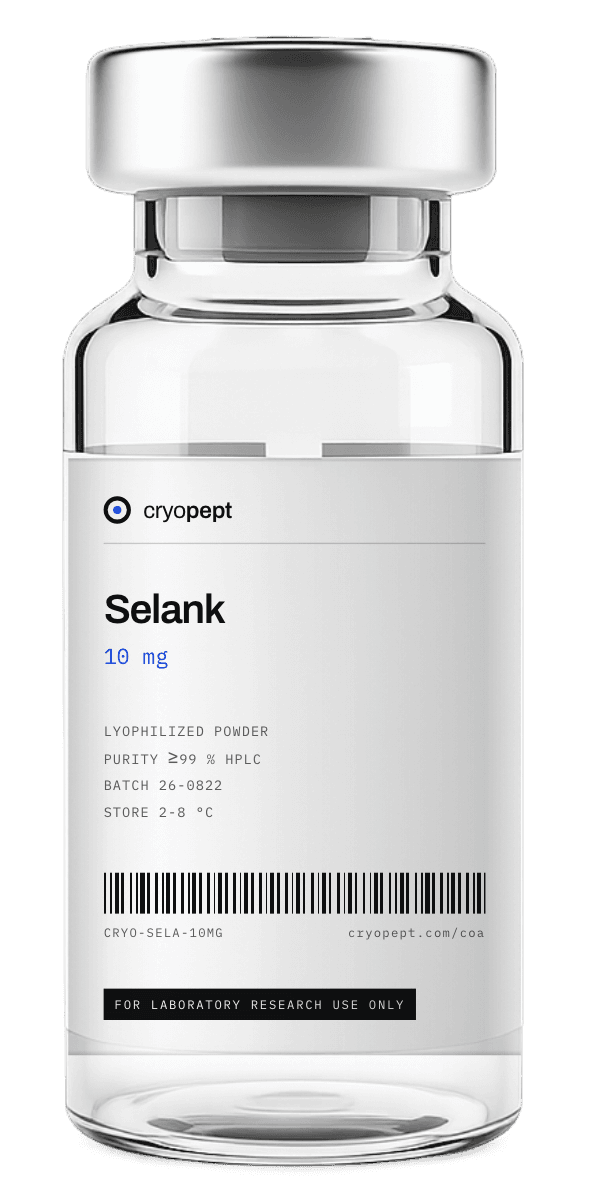
What is Selank?
Selank (C33H57N11O9, 751.9 g/mol) was developed in Moscow at the Institute of Molecular Genetics of the Russian Academy of Sciences, with its pharmacology studied at the Zakusov Institute of Pharmacology. Its first four residues, Thr-Lys-Pro-Arg, are tuftsin, a fragment of immunoglobulin G that the body uses to activate immune cells. On its own, tuftsin is broken down very quickly, so the developers added a Pro-Gly-Pro tail that makes the molecule far more resistant to enzymes.
The result is a peptide that combines tuftsin's immune activity with a pronounced effect on the nervous system. Selank is registered as a medicine in Russia, where it is used as an anxiolytic, but it has no marketing authorisation in the EU, US or elsewhere, so outside Russia it is studied as a research compound.
Selank does not act through a single confirmed receptor. Research points to three complementary routes: it slows the enzymes that break down enkephalins, the body's own calming opioid peptides; it shifts the expression of genes involved in GABA signalling, the brain's main inhibitory system; and it influences cytokine production in immune cells. Together these mechanisms explain why Selank is studied at the meeting point of stress, mood and immunity.
Benefits of Selank reported in research
Evidence level shown on each card.Reduces anxiety in clinical studies
In a 2008 comparative study of 62 patients with generalised anxiety disorder or neurasthenia, Selank produced anxiety reductions on the Hamilton and Zung scales similar to those of medazepam. These trials were conducted in Russia, where Selank is a registered medicine.
Counters fatigue and asthenia
The same Russian trial reported an additional anti-asthenic and mildly activating effect with Selank that was not seen with medazepam, which is why the peptide is often described as calming without sedating.
Protects the body's calming enkephalins
In human serum, Selank inhibited enkephalin-degrading enzymes with an IC50 of about 15 to 20 µM, more potently than the classic peptidase inhibitors bacitracin and puromycin. Patients with generalised anxiety show faster enkephalin breakdown, so this effect is proposed as a key part of Selank's anxiolytic action.
Modulates GABAergic gene expression
In rats, Volkova et al. (2016) measured 84 neurotransmission genes in the frontal cortex and found that Selank changed the expression of several GABA-related genes in a pattern similar to GABA itself, supporting allosteric modulation of the GABA system.
Balances immune signalling
True to its tuftsin origin, Selank suppressed IL-6 gene expression in cultured blood cells from patients with depression and shifted the Th1/Th2 cytokine balance in patients with anxiety-asthenic disorders (Uchakina et al., 2008). Mouse studies also report changes in spleen chemokine and cytokine genes after a single administration.
What the research shows
The central clinical study is Zozulia et al. (2008), published in the Korsakov Journal of Neurology and Psychiatry. Sixty-two patients with generalised anxiety disorder or neurasthenia received Selank (30 patients) or the benzodiazepine medazepam (32 patients). Both groups improved similarly on the Hamilton Anxiety, Zung and Clinical Global Impression scales, while Selank additionally produced anti-asthenic effects. The anxiety reduction correlated with a longer half-life of leu-enkephalin in the patients' blood, linking the clinical effect to the enzyme data.
That enzyme link was established in 2001. Zozulya and colleagues found that patients with generalised anxiety disorder have shortened enkephalin half-life in the blood, and that Selank inhibits enkephalin hydrolysis in plasma with an IC50 of about 15 µM. In a parallel study, Kost and colleagues showed that Selank and its sister peptide Semax both inhibit human serum enkephalinases more strongly than bacitracin or puromycin, and that the active part of the molecule is its pentapeptide fragment.
Molecular studies from the Institute of Molecular Genetics have since mapped how Selank touches the GABA system. Volkova et al. (Frontiers in Pharmacology, 2016) analysed 84 neurotransmission genes in rat frontal cortex 1 and 3 hours after Selank or GABA, and found overlapping expression changes consistent with allosteric modulation of GABA-A receptors. A follow-up study in human IMR-32 neuroblastoma cells (2017) reported similar interactions with GABAergic gene networks.
Evidence is therefore strongest for anxiety-related effects in small Russian trials, supported by consistent enzyme, animal and gene-expression data. Larger, independent trials outside Russia have not yet been published, which is why Selank remains a research peptide in the EU.
Selank - frequently asked questions
What is Selank?
+
Selank is a synthetic heptapeptide, Thr-Lys-Pro-Arg-Pro-Gly-Pro, built from the immune peptide tuftsin plus a stabilising Pro-Gly-Pro tail. It was developed in Moscow and is registered as an anxiolytic medicine in Russia only.
What are the benefits of Selank?
+
Russian clinical studies report anxiety reduction comparable to medazepam together with anti-fatigue effects. Laboratory research shows that Selank protects enkephalins from breakdown, modulates GABA-related gene expression and balances immune cytokines such as IL-6.
Selank vs Semax: what is the difference?
+
Both are Russian heptapeptides ending in Pro-Gly-Pro, but Selank is built on tuftsin and is studied mainly for anxiety and immune balance, while Semax is built on an ACTH fragment and is studied mainly for cognition, BDNF and neuroprotection. Both inhibit enkephalin-degrading enzymes in human serum.
How should Selank be stored?
+
Lyophilized Selank should be kept sealed at -20 °C, dry and protected from light. Reconstituted solutions should be refrigerated at 2-8 °C and not repeatedly frozen and thawed.
Is Selank legal in the EU?
+
Selank is not a controlled substance in the EU, but it is not authorised as a medicine by the EMA or any EU member state; its only drug registration is in Russia. This product is supplied for laboratory research use.