What is SS-31?
SS-31 (D-Arg-Dmt-Lys-Phe-NH2) is a Szeto-Schiller peptide, named after Hazel Szeto and Peter Schiller who created the series. Its formula is C32H49N9O5 and its molar mass 639.8 g/mol. Clinically it is developed as elamipretide by Stealth BioTherapeutics, and older literature also calls it MTP-131 or Bendavia.
The peptide alternates aromatic and positively charged residues, a pattern that lets it pass through cell membranes and concentrate in the inner mitochondrial membrane. Two of its building blocks, D-arginine and 2',6'-dimethyltyrosine, protect it from enzymatic breakdown.
Its target, cardiolipin, is a phospholipid found almost only in the inner mitochondrial membrane. Cardiolipin shapes the folded cristae and anchors the respiratory complexes that make ATP. When cardiolipin is oxidised, energy output drops and free radical production rises. SS-31 binds cardiolipin and helps keep this machinery working, which is why it is described as the first cardiolipin-protective compound.
Benefits of SS-31 reported in research
Evidence level shown on each card.Restores mitochondrial energy production
In aged mice, one treatment with SS-31 reversed the age-related decline in resting and maximal mitochondrial ATP production and coupling efficiency in skeletal muscle within one hour, with no effect on young muscle.
Improves muscle endurance in ageing
Aged muscle became more fatigue resistant one hour after SS-31, eight days of treatment increased whole-animal endurance, and an 8-week study in 26-month-old mice improved exercise tolerance and reversed age-related redox stress.
Protects cardiolipin and electron transport
By binding cardiolipin, SS-31 prevents cytochrome c from turning into a damaging peroxidase while preserving its role as an electron carrier, which protects cristae structure and oxidative phosphorylation.
Better walking distance in mitochondrial myopathy
In the phase 1/2 MMPOWER trial in 36 adults with primary mitochondrial myopathy, the highest elamipretide dose increased 6-minute walk distance by 64.5 m versus 20.4 m on placebo after 5 days, with a significant dose-dependent trend.
First approved therapy for Barth syndrome
On 19 September 2025 the FDA granted elamipretide (Forzinity) accelerated approval to improve muscle strength in patients with Barth syndrome weighing at least 30 kg, based on knee extensor strength gains in the TAZPOWER open-label extension.
Improves heart volumes in heart failure
In a 2017 trial in patients with reduced ejection fraction, a single infusion at the highest dose reduced left ventricular end-diastolic volume by 18 ml and end-systolic volume by 14 ml compared with placebo.
What the research shows
The mechanism was summarised by Hazel Szeto in the British Journal of Pharmacology in 2014: SS-31 selectively binds cardiolipin through electrostatic and hydrophobic interactions, stabilises cristae and promotes oxidative phosphorylation. Extensive animal work in heart, kidney, brain and muscle models showed benefit wherever energy failure drives disease.
Ageing muscle is a standout research area. Siegel et al. (Aging Cell, 2013) used 31P magnetic resonance spectroscopy to show that SS-31 restored in vivo mitochondrial energetics of old mice to young levels in one hour, lowered mitochondrial H2O2 emission and improved endurance. Campbell et al. (Free Radical Biology and Medicine, 2019) confirmed that 8 weeks of SS-31 reversed the decline in maximal ATP production and restored redox balance in aged mouse muscle.
Human trials followed. The MMPOWER study (Karaa et al., Neurology, 2018) reported a dose-dependent gain in 6-minute walk distance in primary mitochondrial myopathy. In Barth syndrome, a genetic disorder of cardiolipin, the TAZPOWER trial missed its primary endpoints in the 12-week crossover part, but at 36 weeks of open-label treatment walking distance improved by 95.9 m (Reid Thompson et al., Genetics in Medicine, 2021). Those data supported the 2025 FDA accelerated approval.
Not every study has been positive: the larger phase 3 MMPOWER-3 trial in mitochondrial myopathy did not meet its primary endpoints, and post hoc analyses are exploring which genetic subgroups respond. Research continues in heart failure, age-related eye disease and other conditions of mitochondrial dysfunction.
SS-31 - frequently asked questions
What is SS-31?
+
SS-31 is a synthetic tetrapeptide that targets the inner mitochondrial membrane and binds cardiolipin to support efficient energy production. It is the same molecule as elamipretide, developed clinically by Stealth BioTherapeutics.
What are the benefits of SS-31?
+
In aged mice, SS-31 restored muscle mitochondrial ATP production within an hour and improved endurance and redox balance. In humans, elamipretide improved walking distance in mitochondrial myopathy and muscle strength in Barth syndrome.
Is SS-31 the same as elamipretide?
+
Yes. SS-31 is the research name from the Szeto-Schiller peptide series, and elamipretide is its international nonproprietary name; it has also been called MTP-131 and Bendavia. The FDA-approved product is sold as Forzinity.
Is elamipretide FDA approved?
+
Yes. The FDA granted elamipretide (Forzinity) accelerated approval on 19 September 2025 to improve muscle strength in people with Barth syndrome weighing at least 30 kg. It is the first approved therapy for that condition.
Is SS-31 legal in the EU?
+
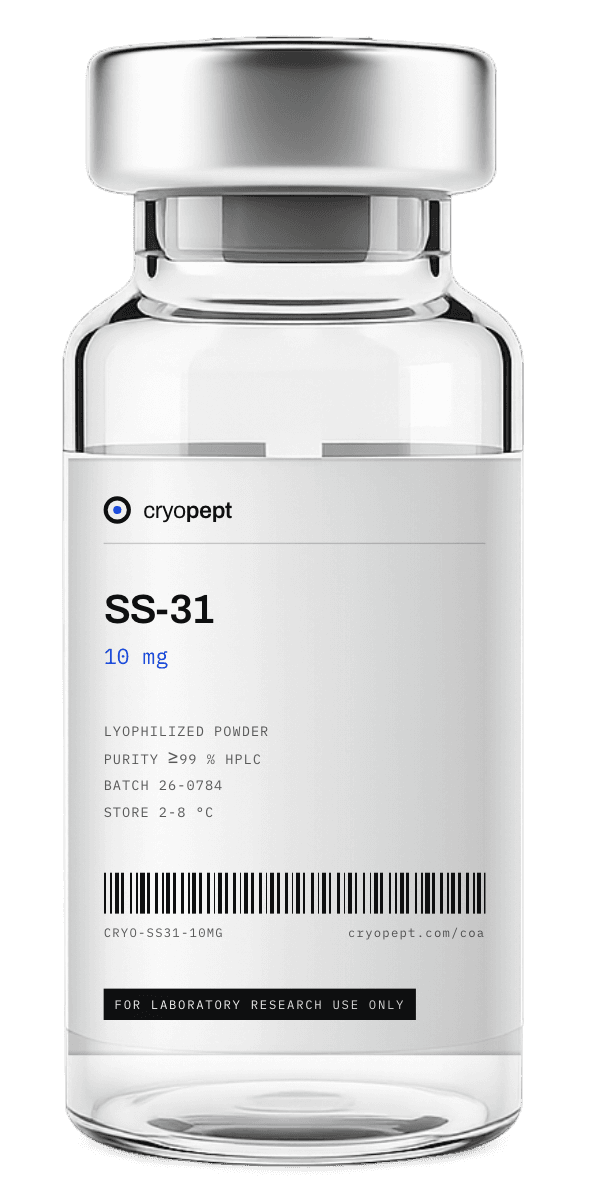
The US approval covers only Forzinity for Barth syndrome, and elamipretide is not an authorised medicine in the EU at the time of this review. SS-31 can be bought as a research peptide, and Cryopept supplies it for laboratory research use.