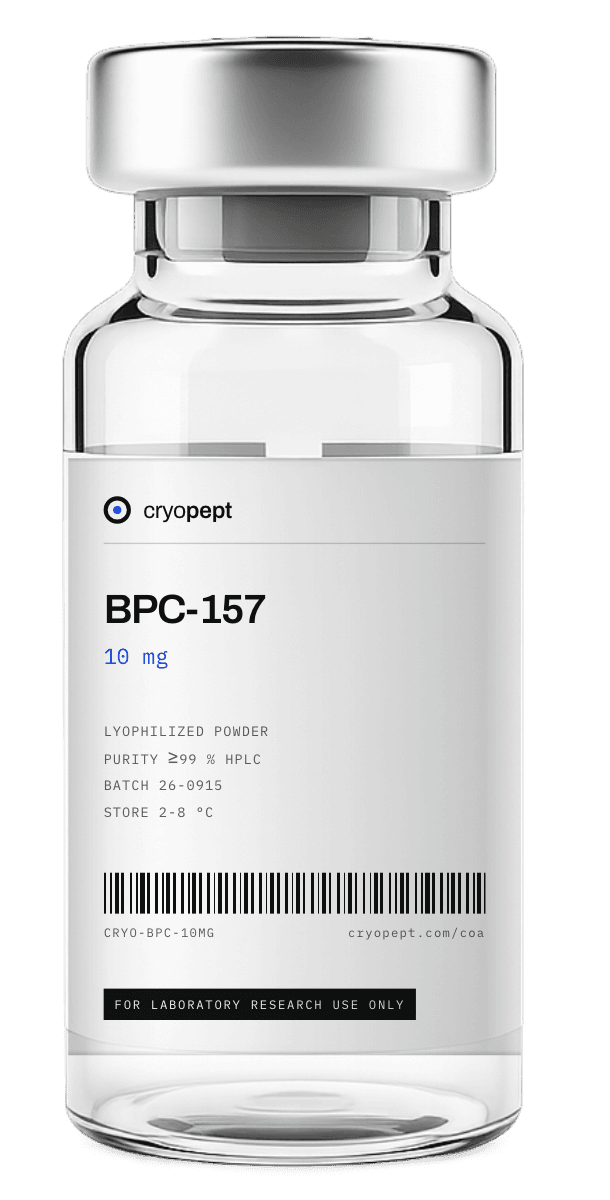
What is BPC-157?
BPC-157 (Body Protection Compound 157, also called PL 14736 or PLD-116) is a pentadecapeptide with the sequence GEPPPGKPADDAGLV, formula C62H98N16O22 and a molar mass of about 1419.5 g/mol. It is a partial sequence of a larger protein first isolated from human gastric juice by Predrag Sikiric's group at the University of Zagreb in the early 1990s.
What sets BPC-157 apart from most research peptides is stability: a proline-rich stretch (PPP) keeps it intact in gastric juice for far longer than typical peptides, so it has been studied by several routes in animals, including in drinking water.
BPC-157 has no single known receptor. In plain terms, cell studies show it switches on signals that help blood vessels grow (the VEGFR2 - Akt - eNOS pathway) and helps tendon cells move and spread into a wound (the FAK - paxillin pathway). Those two effects, more blood supply and faster cell migration, explain much of the healing activity reported in animals.
Benefits of BPC-157 reported in research
Evidence level shown on each card.Faster tendon healing
In a 2003 rat study, BPC-157 restored full integrity of a transected Achilles tendon, with higher load-to-failure and better walking function than untreated controls over 14 days.
Stronger ligament repair
In rats with a cut medial collateral ligament, BPC-157 improved functional, biomechanical and histological healing across 90 days, and it worked when given by several routes (Cerovecki 2010).
Tendon cell migration and survival
In cultured rat tendon fibroblasts, BPC-157 dose-dependently increased cell migration and spreading and raised survival under oxidative stress, via FAK - paxillin activation (Chang 2011).
New blood vessel growth
BPC-157 increased vessel density in chick embryo and endothelial tube assays and sped up blood-flow recovery in ischemic rat hind limbs, linked to higher VEGFR2 expression (Hsieh 2017).
Gut lining protection
Originating from gastric juice, BPC-157 has been studied for decades in rodent models of ulcers and intestinal injury, where it is consistently reported to protect and repair the mucosa.
What the research shows
Musculoskeletal repair is the best-documented area. Staresinic et al. (J Orthop Res, 2003) transected the Achilles tendon in rats and reported that BPC-157 improved load-to-failure, Young's modulus, collagen formation and the Achilles functional index at every time point up to day 14. A 2010 follow-up by Cerovecki et al. found the same pattern in medial collateral ligament injury over 90 days.
Mechanistic work from Chang Gung University in Taiwan explains how. Chang et al. (2011) showed BPC-157 accelerates tendon fibroblast outgrowth and migration by activating FAK and paxillin, while Hsieh et al. (2017) showed it up-regulates and internalises VEGFR2 in human endothelial cells and restores blood flow in ischemic rat limbs.
A 2025 systematic review in HSS Journal (Vasireddi et al.) screened 544 records from 1993 to 2024 and included 36 studies: 35 preclinical and one clinical. It concluded that BPC-157 improved functional, structural and biomechanical outcomes in muscle, tendon, ligament and bone injury models, with no adverse effects in preclinical safety studies.
Human data remain limited. A 2021 retrospective chart review (Lee and Padgett) reported knee pain relief in 14 of 16 patients, and a 2025 two-person pilot reported no changes in heart, liver, kidney or glucose markers after intravenous administration. Neither is a controlled trial, so the evidence base for BPC-157 is still essentially preclinical.
BPC-157 - frequently asked questions
What is BPC-157?
+
BPC-157 is a synthetic peptide of 15 amino acids (GEPPPGKPADDAGLV) based on a protective protein found in human gastric juice. It is one of the most studied tissue-repair peptides, with research focused on tendon, ligament, muscle and gut healing in animal models.
What are the benefits of BPC-157?
+
In rat studies, BPC-157 accelerated healing of transected Achilles tendons and ligaments, protected the gastrointestinal lining and promoted new blood vessel growth. Cell studies link these effects to faster fibroblast migration and VEGFR2 activation. Nearly all of this evidence comes from animal and cell models.
BPC-157 vs TB-500: what is the difference?
+
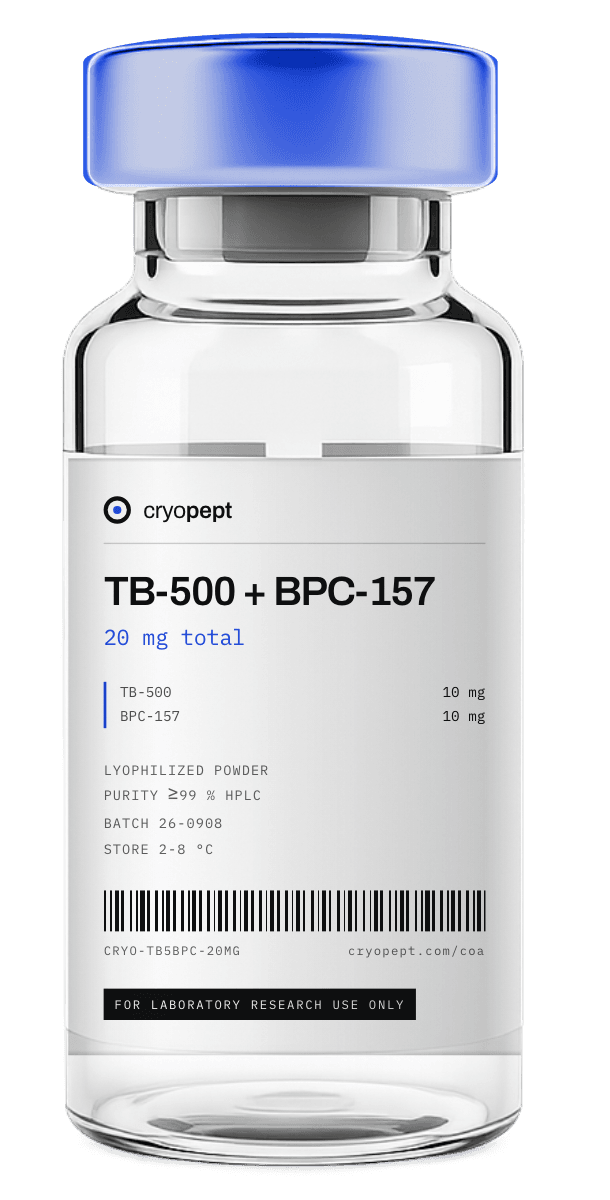
BPC-157 is a gastric peptide fragment that mainly acts on blood vessel growth and fibroblast migration, while TB-500 is modelled on the actin-binding region of thymosin beta-4 and acts on the cell skeleton. Because their mechanisms differ, researchers often study them together, as in the TB-500 + BPC-157 blend.
How should BPC-157 be stored?
+
Lyophilized BPC-157 is best kept sealed at -20 °C, protected from light and moisture. Reconstituted solutions should be refrigerated at 2-8 °C and not repeatedly frozen and thawed.
Is BPC-157 legal in the EU?
+
BPC-157 is not an authorised medicine in the EU or US, and WADA lists it as a prohibited non-approved substance (S0) for athletes. It has no EMA marketing authorisation, so it is not a medicine in the EU; Cryopept supplies it for laboratory research use only.