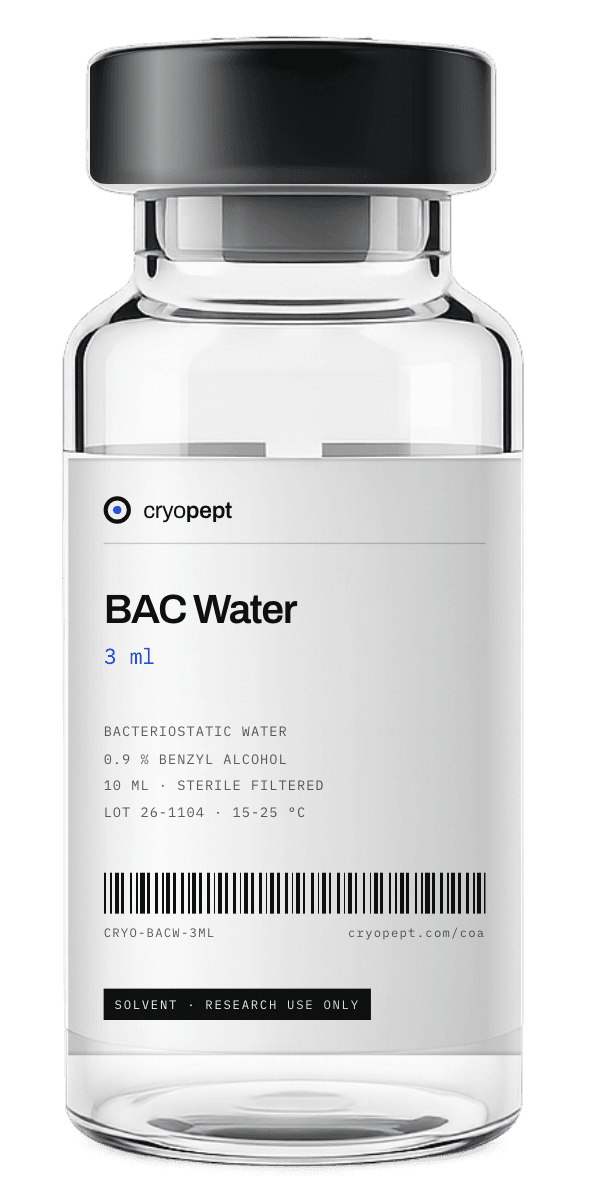
What is BAC Water?
Bacteriostatic water is a pharmacopoeial preparation: the United States Pharmacopeia describes Bacteriostatic Water for Injection as sterile, nonpyrogenic water with benzyl alcohol added as a bacteriostatic preservative, typically at 0.9 % (9 mg per ml). Its only role is to dilute or dissolve other products, and it contains no active ingredient of its own.
The key word is bacteriostatic. Benzyl alcohol, a simple aromatic alcohol (C7H8O), disrupts bacterial cell membranes at this concentration and keeps any microbes introduced during handling from growing. It does not sterilise a contaminated solution instantly, so clean aseptic technique still matters, but it protects the vial over repeated use.
Plain sterile water, by contrast, has no preservative and is meant for single use: once the stopper has been punctured, anything that enters can grow freely. That difference is why multi-use peptide work in the lab is usually built around BAC water.
Benefits of BAC Water reported in research
Evidence level shown on each card.Multi-use from a single vial
Official labelling describes bacteriostatic water as a multiple-dose container from which repeated withdrawals may be made, unlike preservative-free sterile water, which is intended for one-time use.
Inhibits bacterial growth
The 0.9 % benzyl alcohol acts as a bacteriostatic preservative, suppressing the growth of bacteria introduced during repeated access to the vial.
The preferred preservative for peptides and proteins
A 2007 review of licensed parenteral products in the Journal of Pharmaceutical Sciences found that phenol and benzyl alcohol are the two most common antimicrobial preservatives used in peptide and protein products.
Designed as a diluent for dry powders
Bacteriostatic water is indicated only for diluting or dissolving other products, which makes it the standard companion to lyophilized (freeze-dried) peptides that must be brought into solution before laboratory use.
Defined in-use window after opening
Following USP general chapter 797 and CDC guidance, an opened multi-dose vial is typically dated and used within 28 days unless the manufacturer specifies otherwise, giving labs a clear handling standard.
What the research shows
Bacteriostatic water is not an experimental product but a long-established pharmacopoeial preparation. The Hospira prescribing information on DailyMed describes it as sterile, nonpyrogenic water with 0.9 % or 1.1 % benzyl alcohol, a pH of about 5.7 (range 4.5 to 7.0), supplied in multiple-dose containers for diluting or dissolving other products.
Why benzyl alcohol? Meyer et al. (Journal of Pharmaceutical Sciences, 2007) reviewed antimicrobial preservatives across licensed parenteral products and reported that phenol and benzyl alcohol are the most common preservatives in peptide and protein formulations. Selection depends on antimicrobial effectiveness and on not disturbing the conformational stability of the active molecule, which benzyl alcohol generally satisfies at typical concentrations.
Handling standards are defined as well. The CDC and USP chapter 797 treat preserved multi-dose vials differently from single-dose vials: a multi-dose vial may be used for up to 28 days after first puncture unless the manufacturer states otherwise, while preservative-free vials should be used once. Labelling also notes that benzyl alcohol preparations are not suitable for neonates, so preservative-free water is used where benzyl alcohol must be avoided.
BAC Water - frequently asked questions
What is BAC water?
+
BAC water, short for bacteriostatic water, is sterile water containing 0.9 % benzyl alcohol. The benzyl alcohol prevents bacterial growth so the vial can be accessed more than once, and labs use it to dissolve lyophilized peptides.
Bacteriostatic water vs sterile water: what is the difference?
+
Sterile water contains no preservative and is meant for single use once opened. Bacteriostatic water contains 0.9 % benzyl alcohol, which inhibits bacterial growth and allows repeated withdrawals from the same vial for up to 28 days after first puncture.
Why is BAC water used with peptides?
+
Research peptides are shipped as dry lyophilized powders for stability and must be dissolved before use. BAC water is a sterile, preserved diluent, and benzyl alcohol is one of the two most common preservatives in licensed peptide and protein products.
How long does bacteriostatic water last after opening?
+
Under USP chapter 797 and CDC guidance, an opened multi-dose vial is generally used within 28 days unless the manufacturer specifies a different period. Unopened vials keep until the printed expiry date when stored at 20-25 °C.
Is BAC water the same as saline?
+
No. Saline is sterile water with 0.9 % sodium chloride, while BAC water contains 0.9 % benzyl alcohol as a preservative. They share the same percentage but have different ingredients and purposes.