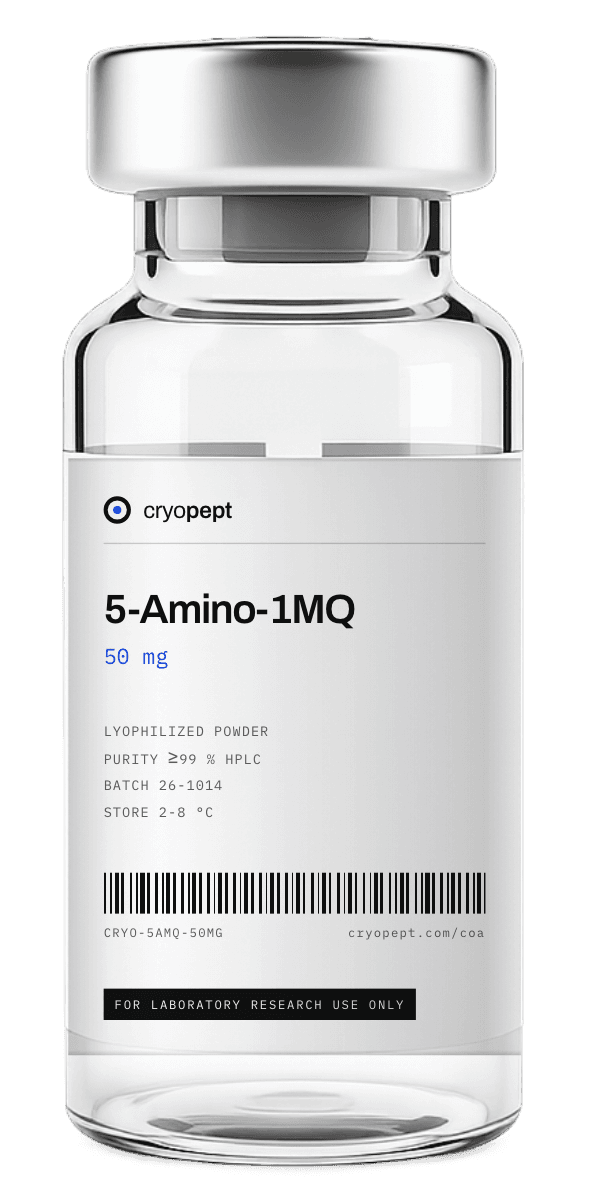
What is 5-Amino-1MQ?
5-Amino-1MQ is not a peptide. It is a small quinolinium cation (C10H11N2+, about 159.2 g/mol for the cation) from a series of methylquinolinium compounds designed at the University of Texas Medical Branch by Harshini Neelakantan, Stanley Watowich and colleagues. In their 2017 structure-activity study in the Journal of Medicinal Chemistry, quinoliniums with a primary amine were among the most potent inhibitors that bind the nicotinamide pocket of NNMT.
NNMT transfers a methyl group from S-adenosyl methionine (SAM) to nicotinamide, producing 1-methylnicotinamide (1-MNA). This reaction pulls nicotinamide away from the NAD+ salvage pathway and consumes methyl groups. Higher NNMT activity in white fat and ageing muscle is therefore linked to lower NAD+ availability and altered cellular energy balance.
By blocking NNMT, 5-Amino-1MQ is reported to lower intracellular 1-MNA and raise NAD+ and SAM in cultured fat cells. It crosses cell membranes well by both passive and active transport, and it did not inhibit related SAM-dependent methyltransferases or NAD+ salvage enzymes in selectivity screens.
Benefits of 5-Amino-1MQ reported in research
Evidence level shown on each card.Reverses diet-induced obesity in mice
In diet-induced obese mice on a high-fat diet, a potent methylquinolinium NNMT inhibitor significantly reduced body weight and white adipose mass, shrank adipocytes and lowered plasma total cholesterol, with no change in food intake and no observable adverse effects.
Raises NAD+ and suppresses lipogenesis in fat cells
In cultured adipocytes, NNMT inhibitors reduced the reaction product 1-MNA, increased intracellular NAD+ and SAM, and suppressed the formation of new fat (lipogenesis).
Improves metabolic and liver markers
A 28-day study in diet-induced obese mice found that 5A1MQ dose-dependently limited weight and fat gain, improved glucose tolerance and insulin sensitivity, and reduced fatty liver, liver triglycerides and liver enzymes ALT and AST.
Activates aged muscle stem cells
In 24-month-old mice with a muscle injury, the NNMT inhibitor increased muscle stem cell proliferation and fusion, produced nearly 2-fold larger regenerating fibres and raised peak muscle torque by about 70 % compared with controls.
Adds to the effect of exercise in ageing
Aged mice treated from 22 to 24 months of age had about 40 % greater grip strength than sedentary controls, versus 20 % for exercise alone, and the combination of treatment and exercise reached about 60 %.
What the research shows
The first in vivo evidence came from Neelakantan et al. in Biochemical Pharmacology (2018). The team profiled the membrane permeability and selectivity of methylquinolinium NNMT inhibitors, showed that they raised NAD+ and SAM and suppressed lipogenesis in adipocytes, and then treated diet-induced obese mice for 11 days. Body weight, white fat mass, adipocyte size and plasma cholesterol fell, while food intake did not change.
Follow-up work from the same group combined NNMT inhibition with diet. Sampson et al. (Scientific Reports, 2021) reported that adding the inhibitor to a reduced-calorie diet normalised body composition in obese mice more than diet alone, and Babula et al. (Diabetes, Obesity and Metabolism, 2024) found dose-dependent improvements in glucose tolerance, insulin sensitivity and fatty liver after 28 days, with good distribution into fat, muscle and liver.
A second research line concerns ageing muscle, where NNMT is overexpressed. Neelakantan et al. (Biochemical Pharmacology, 2019) showed that NNMT inhibition rescued muscle stem cell activity and regeneration in 24-month-old mice, and Dimet-Wiley et al. (Scientific Reports, 2024) reported grip strength gains that added to the effects of exercise.
All published data are preclinical, from cells and mice, and much of it comes from researchers connected to Ridgeline Therapeutics, the company developing these inhibitors. No peer-reviewed human trials of 5-Amino-1MQ had been published at the time of this review, and it is not an approved medicine anywhere.
5-Amino-1MQ - frequently asked questions
What is 5-Amino-1MQ?
+
5-Amino-1MQ (5-amino-1-methylquinolinium) is a small-molecule inhibitor of the enzyme nicotinamide N-methyltransferase (NNMT). It was developed at the University of Texas Medical Branch and is studied in models of obesity and muscle ageing.
Is 5-Amino-1MQ a peptide?
+
No. Despite often being sold alongside peptides, 5-Amino-1MQ is a small quinolinium molecule with a mass of about 159 g/mol for the cation, far smaller than any peptide.
How does 5-Amino-1MQ work?
+
It blocks NNMT, the enzyme that methylates nicotinamide using SAM. In fat cells this lowered 1-MNA and raised NAD+ and SAM levels, which researchers link to changes in fat storage and cellular energy metabolism.
What does the research on 5-Amino-1MQ show?
+
In mice, NNMT inhibition reduced body weight and fat mass in diet-induced obesity without lowering food intake, improved glucose tolerance and fatty liver, and boosted muscle regeneration and grip strength in aged animals. These results have not yet been tested in published human trials.
How is 5-Amino-1MQ related to NAD+?
+
NNMT diverts nicotinamide away from the NAD+ salvage pathway. Inhibiting NNMT with 5-Amino-1MQ increased intracellular NAD+ in cultured adipocytes and muscle cells, which is why it is often researched alongside NAD+.