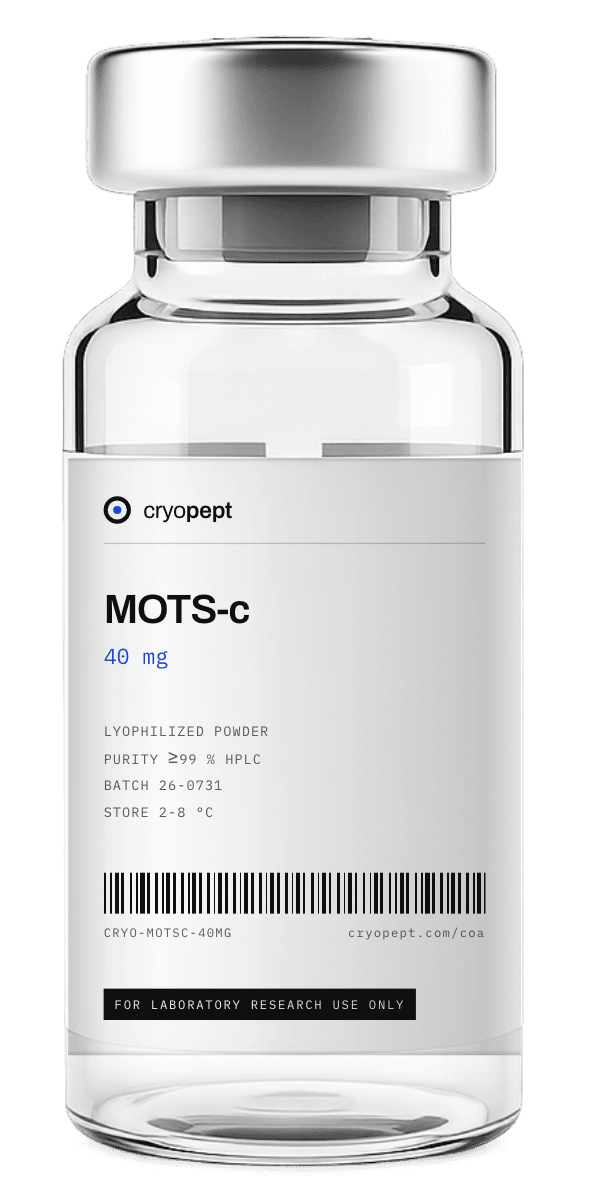
What is MOTS-c?
MOTS-c stands for mitochondrial open reading frame of the 12S rRNA type-c. It was discovered in 2015 by Pinchas Cohen and Changhan Lee at the University of Southern California, who found a short gene hidden inside the mitochondrial 12S rRNA sequence. The resulting peptide (MRWQEMGYIFYPRKLR) has 16 residues, the formula C101H152N28O22S2 and a molar mass of 2174.6 g/mol.
Its discovery changed how scientists see mitochondria: not only as power plants, but as signalling hubs that send hormone-like messages to the rest of the body. MOTS-c belongs to the family of mitochondrial-derived peptides alongside humanin, and it circulates in blood where its levels respond to exercise and age.
Mechanistically, MOTS-c works like a metabolic switch. In cells it slows the folate cycle and purine synthesis, which activates AMPK, the same energy sensor turned on by exercise. Under metabolic stress it can move into the cell nucleus and switch on stress-protective genes, including those controlled by NRF2.
Benefits of MOTS-c reported in research
Evidence level shown on each card.Improves insulin sensitivity
In the 2015 Cell Metabolism study, MOTS-c treatment prevented both age-dependent and high-fat-diet-induced insulin resistance in mice, with skeletal muscle identified as its primary target tissue.
Protects against diet-induced weight gain
Mice on a high-fat diet treated with MOTS-c were protected from diet-induced obesity, an effect linked to AMPK activation and improved glucose handling in muscle.
Boosts physical performance in young and old mice
MOTS-c significantly enhanced running performance in young, middle-aged and old mice, and treatment started late in life (23.5 months) increased physical capacity and healthspan markers; USC researchers reported that elderly mice doubled their treadmill running capacity.
An exercise-responsive human signal
In healthy young men, a stationary-cycling session raised MOTS-c in skeletal muscle nearly 12-fold and in blood plasma by about 50 %, supporting its description as an exercise-induced mitochondrial hormone.
Activates cellular stress defences
Under glucose restriction, MOTS-c moved into the nucleus of cultured cells in an AMPK-dependent way and regulated antioxidant response genes, interacting with the transcription factor NRF2.
What the research shows
The 2015 discovery paper by Lee et al. in Cell Metabolism identified MOTS-c as a peptide encoded within the mitochondrial 12S rRNA. The team showed that it inhibits the folate cycle and de novo purine biosynthesis, leading to AMPK activation, and that MOTS-c treatment in mice prevented age-dependent and diet-induced insulin resistance as well as diet-induced obesity.
In 2018, Kim et al. (Cell Metabolism) reported that MOTS-c translocates to the nucleus during metabolic stress and regulates a broad range of nuclear genes, including those with antioxidant response elements. This was the first evidence that a mitochondrial-encoded factor directly controls the nuclear genome, a concept the authors call mitonuclear communication.
The 2021 Nature Communications study by Reynolds et al. extended the work to ageing. MOTS-c improved physical performance in mice aged 2, 12 and 22 months, regulated muscle metabolism and proteostasis genes, and late-life intermittent treatment increased physical capacity and healthspan. The same paper measured human samples: exercise induced endogenous MOTS-c in both skeletal muscle and circulation.
Human intervention trials with MOTS-c itself have not yet been published in peer-reviewed form, so current benefits are drawn mainly from mouse and cell studies plus human observational exercise data. That makes MOTS-c one of the most active topics in mitochondrial and ageing research.
MOTS-c - frequently asked questions
What is MOTS-c?
+
MOTS-c is a 16-amino-acid peptide encoded in the mitochondrial genome, discovered at the University of Southern California in 2015. It acts as a hormone-like metabolic regulator, mainly in skeletal muscle, and activates the energy sensor AMPK.
What are the benefits of MOTS-c?
+
In mice, MOTS-c prevented diet-induced obesity and insulin resistance and improved physical performance at every age tested, including a doubling of running capacity in old mice. In humans, exercise naturally increases MOTS-c levels in muscle and blood.
Is MOTS-c an exercise mimetic?
+
Researchers often describe it that way because MOTS-c activates AMPK, the same energy pathway triggered by exercise, and because its own levels rise sharply during exercise. Its performance effects so far come from animal studies.
MOTS-c vs SS-31: what is the difference?
+
MOTS-c is a signalling peptide made by mitochondria that acts on metabolism throughout the cell and nucleus. SS-31 is a synthetic peptide that binds cardiolipin inside the mitochondrial membrane to protect energy production directly, so the two are studied as complementary mitochondrial tools.
Is MOTS-c legal in the EU?
+
MOTS-c is not an authorised medicine in any EU country, but it can be bought as a research peptide. Cryopept supplies it for laboratory research use.