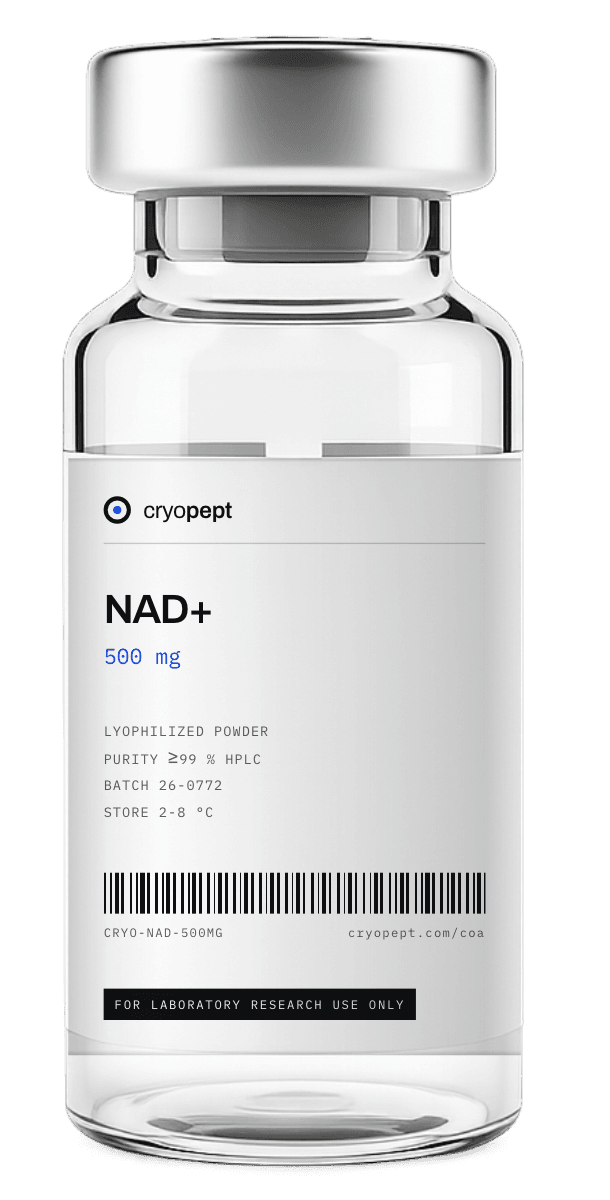
What is NAD+?
NAD+ is not a peptide but a dinucleotide: two nucleotides, one carrying adenine and one carrying nicotinamide (a form of vitamin B3), joined through their phosphate groups. Its formula is C21H27N7O14P2 and its molar mass 663.4 g/mol. It was first identified by Arthur Harden and William Young in 1906 as a cofactor in yeast fermentation.
Inside the cell NAD+ works as an electron shuttle. It collects electrons during glycolysis and the citric acid cycle, becoming NADH, and NADH then delivers them to complex I of the mitochondrial respiratory chain, where the energy is converted into ATP. Without a steady NAD+ supply, this energy chain slows.
NAD+ is also consumed as fuel by three enzyme families: sirtuins, which regulate metabolism and stress resistance; PARPs, which repair damaged DNA; and CD38, an enzyme whose activity rises with age. Because these enzymes use up NAD+, cells must constantly rebuild it, and when consumption outpaces synthesis, NAD+ levels decline.
Benefits of NAD+ reported in research
Evidence level shown on each card.Central to cellular energy production
As the main electron carrier of glycolysis, the citric acid cycle and oxidative phosphorylation, NAD+ is required for ATP production in every cell, a role established by decades of biochemical research.
Fuels sirtuins and DNA repair
Sirtuins and PARP enzymes depend on NAD+ as a substrate, so NAD+ availability links energy status to gene regulation, stress resistance and repair of damaged DNA.
Replenishes a molecule that declines with age
In human skin samples from 49 people aged 0 to 77, NAD+ levels showed a strong negative correlation with age (r = -0.706 in males), while PARP activity and DNA damage increased.
Restoring NAD+ counters age-related decline in mice
In a 12-month mouse study, boosting NAD+ with its precursor NMN suppressed age-associated weight gain, enhanced energy metabolism and physical activity, and improved insulin sensitivity, lipid profile and eye function.
Better muscle insulin sensitivity in humans
In a 10-week randomised, placebo-controlled trial in prediabetic postmenopausal women, raising NAD+ with NMN increased muscle insulin sensitivity and insulin signalling (Science, 2021).
What the research shows
A 2021 review in Nature Reviews Molecular Cell Biology (Covarrubias et al.) summarises the field: NAD+ levels decline across multiple tissues during ageing, and this decline is linked to metabolic disease, neurodegeneration and loss of mitochondrial function, while raising NAD+ improves many of these features in animal models.
Why does NAD+ fall? Massudi et al. (PLoS One, 2012) found in human tissue that rising oxidative DNA damage drives PARP activity, which consumes NAD+. Camacho-Pereira et al. (Cell Metabolism, 2016) showed in mice that expression of the NADase CD38 increases with age and is required for age-related NAD+ decline and mitochondrial dysfunction.
Most intervention research uses NAD+ precursors. Mills et al. (Cell Metabolism, 2016) gave mice NMN for 12 months and reported broad protection against age-related physiological decline without obvious toxicity. In humans, Yoshino et al. (Science, 2021) reported improved muscle insulin sensitivity in prediabetic women taking NMN, and a 2018 Nature Communications crossover trial found nicotinamide riboside raised NAD+ in healthy middle-aged and older adults and was well tolerated.
Direct NAD+ is studied too. In a 2019 pilot study (Grant et al., Frontiers in Aging Neuroscience), NAD+ given as a 6-hour intravenous infusion to healthy volunteers was rapidly and completely removed from plasma for the first 2 hours, and the metabolite profile pointed to fast breakdown by NAD+ glycohydrolase and pyrophosphatase enzymes, an area where more research is needed.
NAD+ - frequently asked questions
What is NAD+?
+
NAD+ (nicotinamide adenine dinucleotide) is a coenzyme found in every living cell. It carries electrons in energy metabolism and is used by sirtuins, PARPs and CD38 to regulate metabolism and repair DNA.
What are the benefits of NAD+?
+
NAD+ is essential for ATP production, DNA repair and sirtuin activity. Research shows NAD+ declines with age, and raising it in mice mitigated age-related decline in metabolism, activity and insulin sensitivity, with early human trials of NAD+ precursors showing metabolic improvements.
Is NAD+ a peptide?
+
No. NAD+ is a dinucleotide coenzyme built from adenine, nicotinamide, two ribose sugars and two phosphates. It is often grouped with research peptides because it is supplied the same way, as a lyophilized powder in a vial.
NAD+ vs NMN and NR: what is the difference?
+
NMN (nicotinamide mononucleotide) and NR (nicotinamide riboside) are precursors that cells convert into NAD+. NAD+ itself is the active coenzyme, so research on NAD+ studies the end molecule directly rather than its building blocks.
Why do NAD+ levels decline with age?
+
Studies point to increased consumption rather than simply reduced production. Human tissue data link age-related NAD+ loss to higher PARP activity from DNA damage, and mouse studies show the NAD-consuming enzyme CD38 rises with age.
Is NAD+ legal to buy in the EU?
+
Yes, NAD+ is a naturally occurring biochemical that is legal to buy in the EU. This vial is intended for laboratory research use.