What is MT-2?
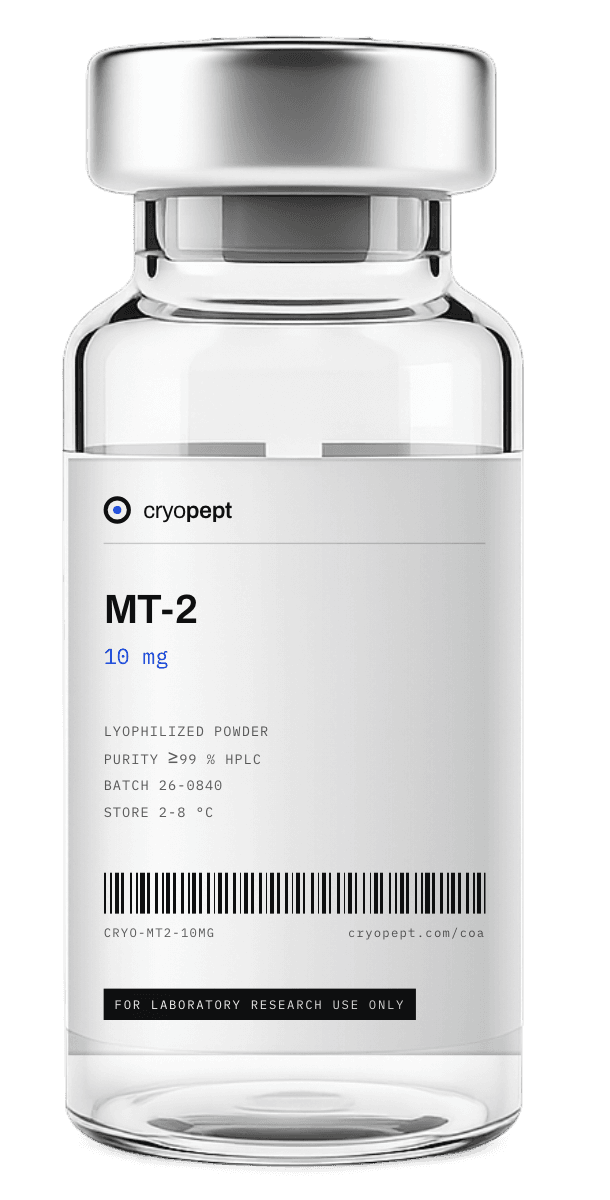
MT-2 is a seven-residue cyclic peptide (C50H69N15O9, 1024.2 g/mol) developed at the University of Arizona in the late 1980s and early 1990s. The research group, including Mac Hadley, Victor Hruby and Robert Dorr, set out to create a more potent and longer-lasting version of α-MSH, the body's own tanning hormone, as a possible way to protect fair skin from UV damage.
Two design choices make MT-2 unusually strong. A lactam bridge between aspartate and lysine locks six of the seven residues into a ring, holding the peptide in its active shape, and a D-phenylalanine residue makes it resistant to protein-cutting enzymes. The result is a molecule that Dorr and colleagues described in 1996 as a superpotent melanotropin.
MT-2 is non-selective: it binds MC1R, MC3R, MC4R and MC5R. MC1R on pigment cells (melanocytes) drives the production of eumelanin, the dark, photoprotective form of melanin. MC3R and MC4R sit mainly in the brain, where they help regulate appetite, energy balance and sexual function. This broad receptor profile is why MT-2 research spans skin biology, obesity and sexual-function science.
Benefits of MT-2 reported in research
Evidence level shown on each card.Increases skin pigmentation without UV
In a 1996 placebo-controlled pilot phase I study at the University of Arizona, Melanotan II produced measurable darkening of the face and upper body in two of three healthy male volunteers. The effect comes from MC1R activation, which switches melanocytes towards eumelanin, the pigment associated with better UV protection.
Superpotent melanocyte activation
In cell-based assays MT-2 activates melanocortin receptors far more strongly than natural α-MSH, raising cAMP and switching on the MITF gene that drives the enzymes of melanin synthesis. Its cyclic structure also keeps it active much longer than the native hormone.
Initiates erections via central MC4R signalling
In a double-blind, placebo-controlled crossover study (Wessells et al., 1998), 8 of 10 men with psychogenic erectile dysfunction developed clinically apparent erections after MT-2. Mean duration of tip rigidity above 80 % was 38 minutes with MT-2 versus 3 minutes with placebo.
Reduces food intake in obesity models
In a landmark 1997 Nature study, MT-2 acting on brain MC3/MC4 receptors inhibited feeding in four different mouse models of overeating, including leptin-deficient ob/ob mice. The work helped establish the melanocortin system as a central regulator of appetite and body weight.
Paved the way for an approved medicine
Bremelanotide (PT-141), a closely related peptide and an active metabolite of MT-2, was developed from this research line and approved by the FDA in 2019 as Vyleesi for hypoactive sexual desire disorder in premenopausal women. That approval validates MC4R as a real therapeutic target, although MT-2 itself is not an approved medicine.
What the research shows
The first human data came in 1996, when Dorr and colleagues published a single-blind, placebo-controlled pilot phase I study in Life Sciences. Three healthy men received MT-2 on alternating days over two weeks. Two of the three volunteers showed increased pigmentation of the face, upper body and buttocks, measured by quantitative reflectance one week after dosing ended, confirming that MT-2 has tanning activity in humans without UV exposure. They also noted two effects that shaped later research: stretching and yawning, and spontaneous penile erections.
Those observations led to a dedicated erectile-function study. In 1998 Wessells and colleagues reported in the Journal of Urology a double-blind, placebo-controlled crossover trial in 10 men with psychogenic erectile dysfunction. MT-2 initiated erections in 8 of 10 men, measured objectively with RigiScan monitoring, with mean rigidity duration of 38 minutes versus 3 minutes on placebo. Because MT-2 acts in the brain rather than on blood vessels, this was one of the first demonstrations of a centrally acting pro-erectile compound.
In parallel, obesity researchers used MT-2 as a tool to map the brain's appetite circuits. Fan et al. (Nature, 1997) showed that MT-2 inhibited feeding in fasted mice, in ob/ob mice, in agouti obese mice and after neuropeptide Y stimulation, while a melanocortin antagonist increased feeding. This work established that MC4R neurons exert a constant brake on appetite, a finding that later led to approved MC4R-targeted medicines.
Development of MT-2 as a drug stopped around 2000 in favour of its derivative bremelanotide, which reached FDA approval in 2019. A separate, linear α-MSH analogue, afamelanotide (Melanotan I), was authorised in the EU in 2014 as Scenesse for the light-sensitivity disorder erythropoietic protoporphyria. MT-2 remains the most widely used research tool for studying the whole melanocortin receptor family at once.
MT-2 - frequently asked questions
What is MT-2 (Melanotan II)?
+
MT-2 is a synthetic cyclic peptide analogue of α-MSH, the hormone that stimulates melanin production. It was developed at the University of Arizona and activates the MC1R, MC3R, MC4R and MC5R melanocortin receptors.
What are the benefits of Melanotan 2?
+
Research reports that MT-2 increases skin pigmentation without UV exposure in small human studies, initiates erections through central MC4R signalling, and suppresses appetite in mouse obesity models. Its derivative bremelanotide became an FDA-approved medicine in 2019.
What is the difference between Melanotan 1 and Melanotan 2?
+
Melanotan I (afamelanotide) is a linear peptide that acts mainly on MC1R and is authorised in the EU as Scenesse for erythropoietic protoporphyria. Melanotan II is a smaller cyclic peptide that also activates brain MC3R and MC4R, so its research covers appetite and sexual function as well as pigmentation.
MT-2 vs PT-141: what is the difference?
+
PT-141 (bremelanotide) is a closely related peptide and an active metabolite of MT-2 that was optimised for sexual-function effects with less pigmentation activity. PT-141 is FDA-approved as Vyleesi, while MT-2 is not an approved medicine.
Is MT-2 legal in the EU?
+
MT-2 is not authorised as a medicine or cosmetic tanning product in any EU country, and several European regulators have warned consumers against using unlicensed tanning injections. It is supplied here only for laboratory research use.